
Microfiber Cleaning Products: Choosing GSM, Blend & Pile for Mops and Cloths
Microfiber Cleaning Products: Choosing GSM, Blend & Pile for Mops and Cloths
Microfiber cleaning products are specified by four measurable variables — fiber blend ratio, fabric weight (GSM), pile or loop structure, and mop pad category — not by the generic names that appear in most catalogs. Two items sold under the same microfiber cloth heading can differ in polyamide content, grams per square meter, surface construction, edge finishing and water absorption behavior, and those differences decide whether the product removes soil or merely moves it across the surface.
This guide is written for importers, distributors, brand owners and procurement teams who need to compare microfiber cleaning products on specification rather than on description. It defines each selection variable, applies it to verified cloth and mop pad models from Pa Tin Da Group Co., Ltd — a microfiber manufacturer established in 2004 and based in Foshan, Guangdong, China — and closes with the compliance, sampling and lead-time questions that usually decide a bulk order.
Why Product Names Are Not a Buying Specification
Microfiber describes a fiber class, not a performance grade. The word tells a buyer that the filament is finer than conventional textile fiber. It does not tell them the blend ratio, the fabric weight, the surface construction or the intended cleaning task. A purchase order that references only the category name leaves the most important variables open, and suppliers can quote compliantly against very different products.
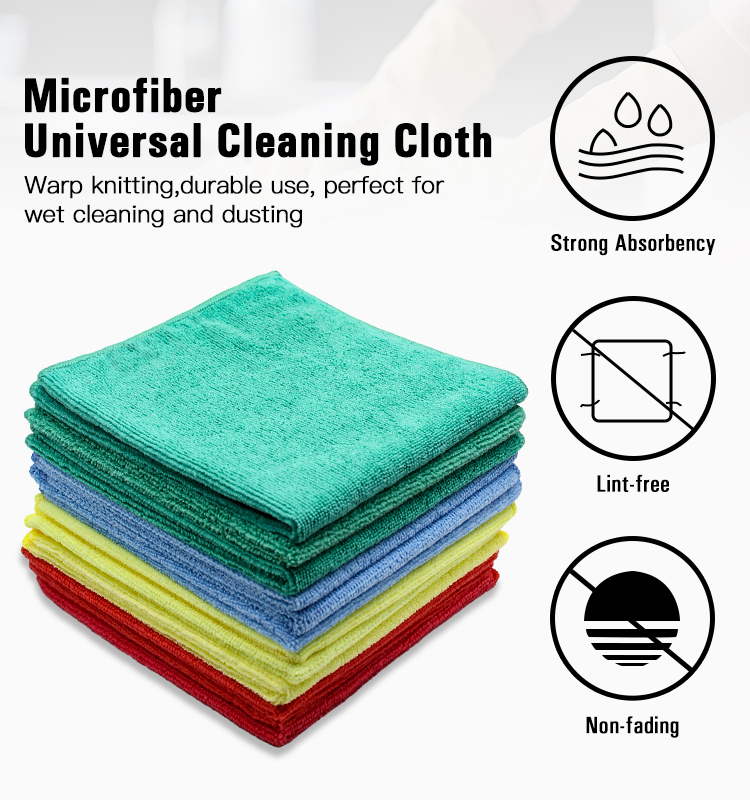
Pa Tin Da’s own range demonstrates the problem. Model MJ-001 is a universal household cleaning cloth specified at 85% polyester / 15% polyamide, with a standard size of 40×40 cm and a GSM range of 180–450. Model MJ-002 is also a household terry cleaning cloth, but it is specified at 80% polyester / 20% polyamide, 30×30 cm, 300 gsm, and roughly 27 grams net weight per cloth. Both absorb seven times their own weight in liquid, and both are documented as lint-free. They are not the same product, and a quote that says only microfiber cloth does not identify which one a buyer will receive.
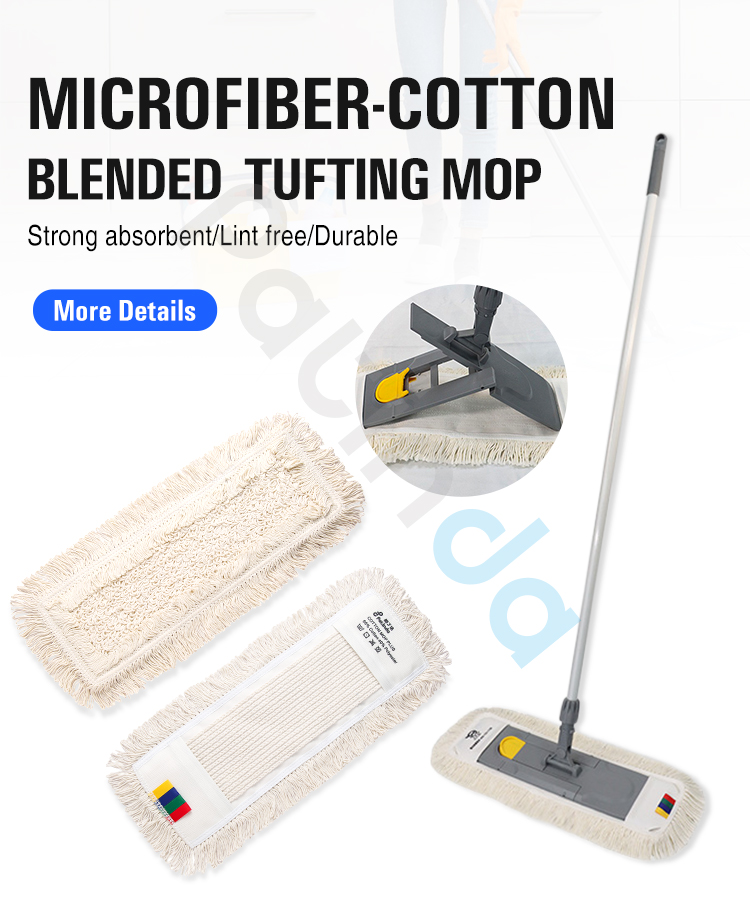
The same ambiguity runs through mop pads. Model MP-006 is a tufted-loop pad built from 40% cotton and 60% polyester blended yarn. Model MP-020 is built from microfiber plus PET blended fabric and adds a red PET abrasive stripe to a white microfiber main pile. Model MP-014 uses a microfiber and nylon blended fabric with a striped pile. Three mop pads, three different fiber systems, three different floor-cleaning behaviors.
The practical consequence is that specification has to be written before price is compared. Asking for a quotation on microfiber cloth produces a price that cannot be compared to anything, because the underlying product was never defined.
Industry Background: A Category Defined by Specification
The commercial weight of this category is considerable. Dataintelo values the global microfiber cleaning cloth market at approximately USD 3.8 billion in 2025 and projects it to reach USD 27.5 billion by 2034. On the supply side, Volza recorded 10,544 microfiber towel export shipments from China between June 2024 and May 2025, reflecting China’s position as the largest exporter in the category.
The demand drivers behind those figures are increasingly technical rather than promotional. According to Global Growth Insights, microfiber products reduce chemical usage by up to 60% and water consumption by up to 90% compared with traditional cleaning tools. Buyers pursuing those reductions in hospitality, healthcare, automotive and facility-management programs need products whose absorbency, lint behavior and surface safety are predictable — which is why specification language has become part of the procurement process itself.
Compliance expectations have moved in the same direction. OEKO-TEX Standard 100 is the dominant safety certification for microfiber textiles and requires testing against more than 1,000 harmful substances, per OEKO-TEX Service GmbH. The Global Recycled Standard (GRS), as described by DK Fiber, requires a minimum of 20% recycled content and traces the entire production chain. Alongside these, buyers now routinely ask for quality-management and social-audit documentation. Key global participants in the microfiber cleaning market include 3M, Freudenberg Group, Toray Industries and Libman, according to Cognitive Market Research and Business Research Insights — a group that competes on both product engineering and documentation readiness.
For a manufacturer, the response to this environment is not a broader catalog. It is a catalog in which every article carries a blend ratio, a weight, a construction description and a compliance file.
The Four Specification Variables in Microfiber Cleaning Products
Four variables carry most of the decision, and they are independent of one another: a high-GSM cloth can be knitted with an open terry loop or a dense fine-rib surface, and an 80/20 polyester-polyamide fabric can be built as terry, waffle or striped weave. Buyers should specify all four, in the order below.
1. Fiber Blend Ratio
Microfiber cleaning fabrics are commonly written as a polyester/polyamide ratio such as 80/20 or 85/15, and that ratio is the first number a buyer should read, because it identifies the fiber system rather than the product family.
Within the Pa Tin Da range, MJ-001 is specified at 85% polyester / 15% polyamide and MJ-002 at 80% polyester / 20% polyamide. Blended systems extend well beyond that pair. Model MJ-016 combines microfiber with PET in a two-layer construction. Model MP-006 uses 40% cotton + 60% polyester blended yarn. Model MP-014 uses microfiber and nylon blended fabric. The PU Coated Microfiber Cloth (PU-001) is specified at 70% polyester / 20% PU / 10% polyamide, and the Microfiber Bamboo Fiber Cloth (MW-003) at 60% polyester / 20% polyamide / 20% bamboo fiber.
2. GSM and Fabric Weight
GSM (grams per square meter) is the standard weight measure for cloth, and it is one of the two variables that most directly shapes how a product feels in the hand and how much liquid it holds per unit area. It is also the number buyers most often leave unstated.
Documented examples in this range include:
- MJ-001 — 180–450 gsm (specified as a range across the construction)
- MJ-002 — 300 gsm, with a net weight of approximately 27 grams for a 30×30 cm cloth
- MD-020 — 250–350 gsm, available in 30×30 cm and 40×40 cm
For automotive and heavier-duty drying cloths the weight band rises: MJ-021 is specified at 250–500 gsm, MJ-022 at 300–500 gsm, and the twisted-loop cloths MJ-023 and MJ-030 at 500–1000 gsm.
There is an important structural difference between cloths and mop pads in how weight is documented. Cloth models are generally quoted in GSM, while Pa Tin Da’s mop pads are documented as single-piece refill weight in grams:
- MP-014 — 100 g / 115 g per pad
- MP-015 — 75 g / 110 g refill
- MP-006 — 165 g / 200 g per pad
- MP-020 — 80 g / 95 g per pad
- MT-003 — 200 g / 300 g per refill
A buyer comparing a cloth quotation stated in GSM against a mop quotation stated in grams per piece is comparing two different metrics. Both should be requested in the same unit before a cost comparison means anything.

3. Pile and Loop Structure
Surface construction decides what the product does with the soil it collects. The same fiber blend knitted two different ways produces two different cleaning tools, so the construction description belongs in the specification alongside the blend and the weight.
Documented constructions across this range include:
- Warp-knitted terry surface — specified on MJ-002, and as a warp knitting terry texture on MJ-001
- Striped weave — MD-020, with a high-density locking edge stitched at 10–12 stitches per inch and multiple weave patterns available
- Waffle structures — MS-075 (honeycomb weave), MS-074 (mini waffle grid with plaid check pattern) and GFM-002 (high-density waffle microfiber)
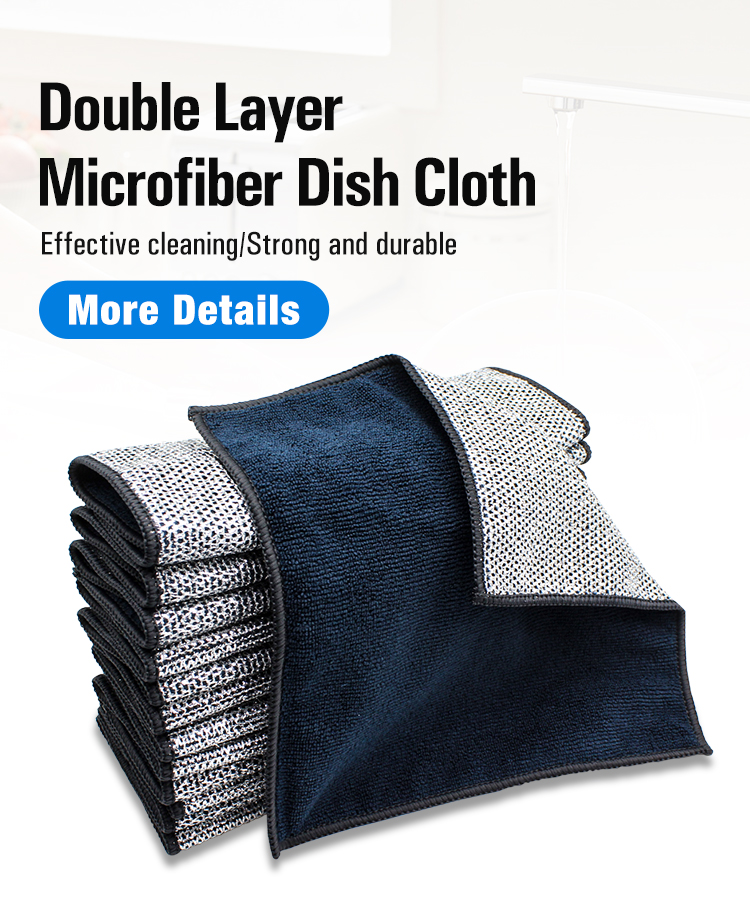
- Double-layer construction — MJ-016, where a PET mesh side handles stain scrubbing and a microfiber side handles water absorption
- Twisted loop — the twisted microfiber/PET loop absorbent surface on MP-015, and the twisted fiber loop technology on MJ-023 and MJ-030
- Tufted loop with fringe edge — MP-006
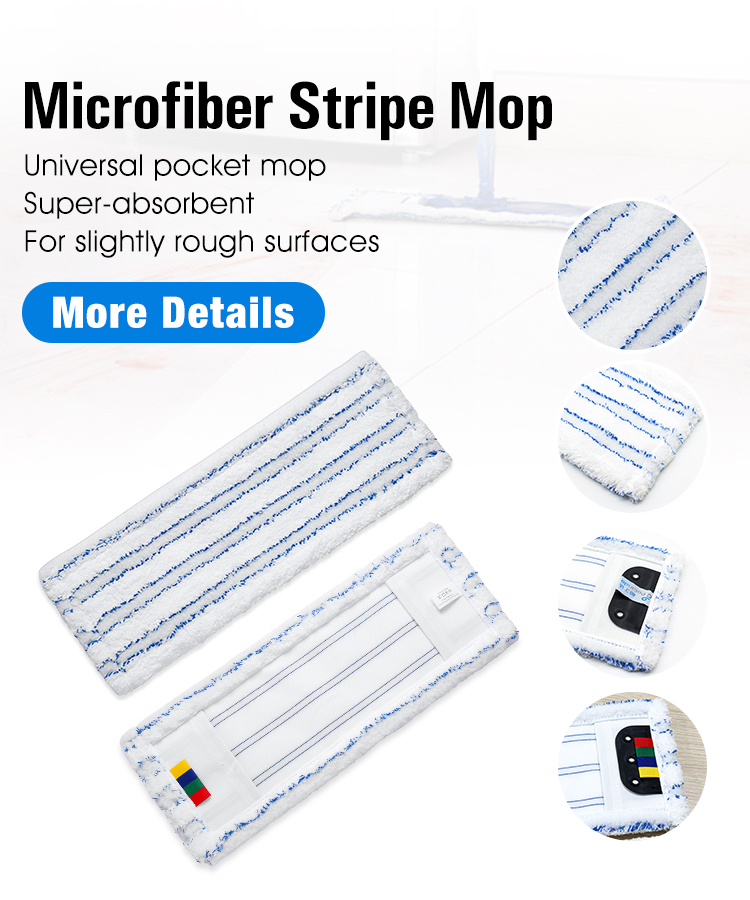
- Mixed striped pile — MP-014, where microfiber and nylon are combined in a striped pile for rough floor dirt capture
- Abrasive stripe — MP-020, pairing a white microfiber main pile with a red PET abrasive stripe for stubborn stain removal
- Chenille pile — MM-067 and MM-069
- Coral fleece — PET-001 and MJ-070
- Terry loop strip — MT-003, with an ultrasonic sealed cutting strip edge
- Fine rib weave — MJ-013, documented as improving friction for combined cleaning and polishing
The selection rule is task-based rather than brand-based. A double-layer cloth with a PET mesh face is specified for scrubbing. A twisted-loop cloth in the 500–1000 gsm band is specified for high-volume liquid pickup on paint and glass. A tufted-loop mop pad is specified for combined dry sweeping and wet mopping. Each of those is a construction decision that can be written into a purchase order.
4. Mop Pad Category and Backing System
For mops, the decision is not only the fabric on the working face but the fixing system on the back, because the backing determines which handle assembly the pad fits and how quickly a cleaning team can change it between zones.
Pa Tin Da documents three attachment approaches in this range:
- Double-pocket fixing with a color-coded classification tag — MP-014, MP-006 and MP-020. Each carries a four-color classification identification label for area management, which lets a facility dedicate specific colors to specific zones.
- Full velcro sticker matching an aluminum mop frame — MP-015, supplied as an adjustable set with a thickened telescopic aluminum rod and a rotating mop head.
- Spiral plastic socket for pole connection — MT-003, a terry loop strip mop.
Size conventions also differ by family. Pocket-style pads are documented at 40 cm and 50 cm widths, the velcro refill at 18-inch and 24-inch sizes, and the strip mop refill at 35×10 cm. Custom sizes are available across the range.
Step-by-Step: How to Specify a Microfiber Cloth or Mop Pad
Step 1 — Define the cleaning task in mechanical terms. Separate dry dust and hair pickup, wet liquid absorption, polishing and scrubbing into distinct requirements. A single surface rarely optimizes all four, which is why MP-020 pairs a microfiber main pile with a red PET abrasive stripe instead of using one uniform surface.
Step 2 — Set the fiber blend ratio. Record the polyester/polyamide percentage, or the blended system where the product is not a polyester/polyamide construction — for example the 40% cotton and 60% polyester yarn in MP-006, the microfiber and nylon blend in MP-014, or the microfiber plus PET laminate in MJ-016.
Step 3 — Set the weight band. For cloths, specify GSM (300 gsm on MJ-002, or the 250–350 gsm band used on MD-020). For mop pads, specify refill weight per piece (165 g / 200 g on MP-006) and ask the supplier to state the equivalent GSM where the pad dimensions are fixed.
Step 4 — Choose the pile or loop structure. Match the construction to the task: terry for general absorbent wiping, waffle for structured wiping surfaces, twisted loop for high-volume drying, tufted loop for combined sweeping and mopping, abrasive stripe for stubborn floor soil, and mesh laminate for scrubbing.
Step 5 — Choose the backing system and the size. Confirm the fixing method (double pocket, velcro, elastic loop or socket) against the handle assemblies the cleaning team already uses, and confirm pad width in centimetres or inches.
Step 6 — Confirm edge finishing and compliance. Edge construction is documented across the range as double stitching, overlock binding, ultrasonic cutting, laser cutting, die cutting and high-density locking edges at 10–12 stitches per inch. Then confirm the certification file that applies to the destination market, not to the category in general.
Where These Specifications Matter: Five Use Cases
Household cleaning and kitchen work. A 300 gsm warp-knitted terry cloth such as MJ-002 is documented for hotel sanitation, home kitchen cleaning, furniture maintenance, commercial property cleaning and bathroom cleaning. A 28-gram double-layer cloth such as MJ-016 is documented for tableware washing and cookware maintenance, where a PET mesh scrubbing face is needed alongside the absorbent face.
Glass, mirror and polished surfaces. Fine-weave and laser-cut constructions are documented for streak-free and lint-free polishing: MJ-013 (fine rib weave, 180–320 gsm) and MW-002 (circular knit with scalloped laser cut edge, 200–240 gsm). Glass washer covers such as CG-001 are specified at 650–680 gsm for high-density plush absorption on smooth glass.
Automotive care and detailing. Twisted-loop cloths in the 500–1000 gsm band (MJ-023 and MJ-030) and long-plush terry constructions (MJ-021 at 250–500 gsm, MJ-022 at 300–500 gsm) are documented as lint-free, streak-free and scratch-safe for automotive paint and glass, absorbing up to seven times their own weight in liquid.
Commercial floor programs. Color-coded pocket pads — MP-014, MP-006 and MP-020 — are documented for hotel cleaning services, hospital sanitation, restaurant catering and commercial property maintenance, with the four-color classification tag supporting zone management. MP-014 is documented as reusable over 300 washing cycles.
Distribution and private-label programs. Customization is available across size, weight, logo, material, fabric texture, printing, color, accessories, packaging, shipping label and GSM. Pa Tin Da’s documented customer base includes retail distributors, auto care brands, gym brands and janitorial wholesalers, with order quantities documented between 1,000 and 50,000 pieces and reusable service life documented at 6–12 months after repeated washing.
Specification Comparison Tables
Cloth Models Compared
| Model | Product | Material | Standard size | Weight | Structure | Documented performance |
|---|---|---|---|---|---|---|
| MJ-001 | microfiber cleaning cloth (universal household) | 85% polyester / 15% polyamide | 40×40 cm, customizable | 180–450 gsm | Warp knitting terry texture; double stitched edge | Absorbs 7× own weight; lint-free; non-fading |
| MJ-002 | Microfiber Universal Cleaning Cloth (household terry) | 80% polyester / 20% polyamide | 30×30 cm, customizable | 300 gsm; approx. 27 g net | Warp-knitted terry surface; double stitching | Absorbs 7× own weight; lint-free |
| MD-020 | Microfiber Universal Towel (striped kitchen cloth) | 80% polyester / 20% polyamide | 30×30 cm and 40×40 cm, customizable | 250–350 gsm | Striped weave; 10–12 stitches per inch locking edge | Absorbs 7× own weight; lint-free; machine washable |
| MJ-016 | Double Layer Microfiber Dish Cloth | microfiber / PET | 30×30 cm, customizable | 28 g per piece | Double-layer: PET mesh side + microfiber side | Oil stain removal; wet and dry use |
Mop Pad Models Compared
| Model | Product | Material | Size | Refill weight | Structure and backing | Documented performance |
|---|---|---|---|---|---|---|
| MP-014 | Microfiber Stripe Mop | microfiber + nylon blended fabric | 40 cm / 50 cm | 100 g / 115 g | Mixed microfiber and nylon striped pile; double pocket back with color-coded tag | Absorbs 7× own weight; picks more dust than a regular mop; reusable over 300 washing cycles |
| MP-015 | Microfiber Twisted Wet Mop | microfiber + polyester (PET) | 18 in / 24 in | 75 g / 110 g | Twisted microfiber/PET loop surface; full velcro back; telescopic aluminum rod | Strong water absorption; effective dirt capture; lint-free; reusable |
| MP-006 | Microfiber-Cotton Blended Tufting Mop | 40% cotton + 60% polyester blended yarn | 40 cm / 50 cm | 165 g / 200 g | Tufted loop front with fringe edge; double pocket back with four-color tag | Good dust and hair pickup; lint-free; tuft does not loosen during cleaning |
| MT-003 | Microfiber Terry Wet Mop | 80% polyester + 20% polyamide microfiber | 35×10 cm | 200 g / 300 g | Terry loop strip; ultrasonic sealed strip edge; spiral plastic socket | High water absorption; strong dirt pickup; lint-free |
| MP-020 | Microfiber Abrasive Mop | microfiber + PET blended fabric | 40 cm / 50 cm | 80 g / 95 g | White microfiber main pile + red PET abrasive stripe; double pocket back with four-color label | Strong dust and hair capture; scratch-free on marble, hardwood and ceramic tile |
Frequently Asked Questions
What certifications should I verify before placing a bulk order for microfiber cleaning products?
Certification requirements depend on the destination market, but the core file for this category covers product safety, quality management, occupational health and safety, social audit and packaging regulation. For microfiber cleaning cloths, model MJ-001 holds OEKO-TEX STANDARD 100 certification (certificate number 20.HCN.36448, issued by Hohenstein Laboratories GmbH & Co. KG under standard OEKO-TEX® STANDARD 100, EN ISO 17050-1). Towel and mop manufacture is certified to ISO 9001:2015 (certificate CN24/00007747) and ISO 45001:2018 (certificate CN24/00007748), both issued by SGS United Kingdom Ltd. The company also holds SMETA (Sedex Members Ethical Trade Audit) certification ZAA600123152, issued by Benchmarks Company Limited and covering the ETI Base Code, SMETA Minimum Requirements and SMETA Auditor Manual across labour standards, health and safety, environment and business ethics. For European distribution, German Packaging Act (VerpackG) registration DE3922560298890 is held under the LUCID register, and French REP Textile UIN FR337512_11LKPC is held for textiles. Buyers should request the certificate that matches their specific market rather than accepting a general compliance statement.
Can one supplier deliver both cloths and mop pads to a matched blend and GSM specification?
Yes, provided the supplier controls fabric formation and finishing rather than only cutting and sewing. Pa Tin Da Group Co., Ltd operates a 45,000 m² manufacturing plant in Foshan, Guangdong, with more than 10 fully automatic production lines for cloth cutting and sewing and over 450 sets of production machinery, supported by an R&D team of 17 engineers. Production is organized around OEM and ODM models, with customization available across size, weight, logo, material, fabric texture, printing, color, accessories, packaging, shipping label and GSM, and quality control documented at 100% test. This matters when a buyer needs a 300 gsm terry cloth and a 165 g pad refill within the same program, because blend consistency across cloth and mop lines depends on the same upstream fabric discipline.
What drives the cost of a microfiber cloth or mop pad?
Cost in this category follows specification, which is why a quotation without a specification cannot be evaluated. The documented cost drivers across this range are the fiber blend system (a polyester/polyamide construction, a cotton-blended yarn such as the 40% cotton + 60% polyester used in MP-006, or a laminate such as the microfiber and PET construction in MJ-016), the weight band (180–450 gsm on MJ-001 versus 500–1000 gsm on MJ-023 and MJ-030), the construction complexity (striped, waffle, tufted, twisted-loop or abrasive-stripe surfaces), the edge finishing (double stitching, overlock binding, ultrasonic or laser cutting, and 10–12 stitches per inch locking edges), and the packing and customization scope. Buyers should compare quotations at a fixed specification — same blend, same GSM or refill weight, same size, same edge — rather than at the category level.
How should a buyer validate a specification before committing to bulk production?
Validation starts with a written specification covering the four variables: blend ratio, weight (GSM for cloths, refill grams for pads), pile or loop structure, and backing or edge construction. Custom sizes, colors, logos and GSM levels are available across the range, so a sample can be aligned to the intended line rather than to a stock article. Documented minimum order quantity is 3,000 PCS. For private-label programs, customization covers custom logo, custom size and color, printing, packaging and shipping label, and reusable service life is documented at 6–12 months after repeated washing while lint-free and high-absorbency behavior is maintained.
What is the production lead time, and how should a buyer plan around it?
Documented production lead time is 30–45 days, with monthly capacity of 182,022 kg and annual output of 2,184,270.46 kg. Export ratio is 98%, with main markets including the United States, Canada, Australia, the United Kingdom, Germany, France, Italy, the Netherlands, Russia, Japan, South Korea, Switzerland, Sweden, Turkey and Saudi Arabia. Buyers running multi-site or multi-quarter programs should confirm lead time against order quantity, since documented order quantities in this customer base range from 1,000 to 50,000 pieces, and after-sales service is documented as available. To start a specification review, request the product catalog and share the target blend, weight and construction — samples and quotations can then be arranged directly with the manufacturer.

Conclusion
Selecting microfiber cleaning products by generic name is a shortcut that costs buyers control over the product. The variables that determine real performance — fiber blend ratio, GSM or refill weight, pile and loop structure, and mop pad category and backing — are all documented, all comparable, and all available to be written into a purchase order before a single unit is produced.
The verified models in this guide show how wide the specification space is: from a 300 gsm, 30×30 cm warp-knitted terry cloth (MJ-002) to a 500–1000 gsm twisted-loop drying cloth (MJ-023, MJ-030); from a 28-gram double-layer scrubbing cloth (MJ-016) to a 200-gram tufted-loop mop refill in 40% cotton and 60% polyester (MP-006); from a color-coded pocket pad (MP-014) to an abrasive-stripe pad designed for stubborn floor soil (MP-020).
Pa Tin Da Group Co., Ltd manufactures across these categories from a 45,000 m² facility in Foshan, Guangdong, with OEM and ODM production, documented certification files and a 30–45 day production lead time.
Next step: define the specification, then request the sample.
Share your target blend ratio, GSM or refill weight, pile structure and pad size. Pa Tin Da Group Co., Ltd will confirm the closest documented construction, prepare samples for validation, and return a quotation at a fixed specification.
Email: sale@microfiberchina.com | WhatsApp / Tel: +86 13902254847 | Website: www.microfiberchina.com
Address: No. 2, South Sanxiang Rd., Xintian Ind. Zone, Xiqiao Town, Nanhai, Foshan, Guangdong, China
Download the full product catalog: Pa Tin Da E-Catalog 2024 (PDF)
Have Questions or Need More Details?
Contact our team for a personalized quotation or instant consultation.
Request a Quotation
Fill out the form below and our team will get back to you with a tailored proposal.
WhatsApp Direct Chat
Prefer to chat in real-time? Message us on WhatsApp for instant assistance & quick answers.
- Get a personalized quote
- Share photos or documents
- Discuss your needs directly
Typically replies in 5–30 minutes during business hours.