Matching Microfiber Cleaning Products to Project Conditions
Buyers evaluating microfiber cleaning products for a new project often begin with the wrong question. 'Which product is best?' is less useful than 'What conditions will this product work in?' A hotel housekeeping mop, a car wash drying towel, and a kitchen wipe face very different demands even when they share the same 80% polyester / 20% polyamide microfiber base.
This guide explains how to match microfiber cleaning products to project conditions. It is written for procurement teams, distributors, and brands in the research and evaluation stage, and uses real product specifications and factory capabilities from Pa Tin Da Group Co., Ltd., a microfiber cleaning products manufacturer based in Foshan, Guangdong, China, founded in 2004.
Why Project Conditions Matter More Than the 'Microfiber' Label
'Microfiber' describes fiber fineness, not a finished product's behavior. The same base material can be made into a warp-knitted terry cleaning cloth at 300 gsm, a twisted-loop auto detailing towel at 500–1000 gsm, or a waffle kitchen towel at 200–400 gsm. These are different tools with different failure modes.
Three working conditions should drive specification:
- Water exposure and wet-dry cycles. Products used for wet mopping or car washing must survive frequent immersion and repeated drying. Edge construction and fiber loop structure determine whether a product frays or holds its shape.
- Friction and scrubbing intensity. High-frequency scrubbing demands a durable pile and a design that does not shed lint or scratch the substrate.
- Surface sensitivity. Automotive paint, glass, mirrors, marble, and hardwood each require different levels of scratch protection.
A mismatch creates visible cost. A thin, non-sealed household cloth used in a hotel wet-mop cycle wears quickly and leaves lint. A high-gsm car towel used for kitchen grease may be over-specified, slow to dry, and harder to wash. Project-based selection starts with the environment, not with a catalog page.
The Market Context for Project-Based Microfiber Cleaning Products
Demand for microfiber cleaning products is broad and still growing. Industry estimates value the global microfiber cleaning cloth market at approximately USD 3.8 billion in 2025 and project it to reach USD 27.5 billion by 2034 (Dataintelo). The household use segment is expected to lead this market with a 40.0% share in 2025, which explains why household, kitchen, and glass products remain central to most sourcing programs.
China is the world's largest exporter of microfiber towels, recording 10,544 shipments between June 2024 and May 2025 (Volza). For buyers outside China, this makes supplier verification more important, because export volume alone does not confirm quality or compliance.
Microfiber also performs well on sustainability metrics. Compared with traditional cleaning tools, microfiber products can reduce chemical usage by up to 60% and water consumption by up to 90% (Global Growth Insights). Hotel chains and car wash operators increasingly include these parameters in their procurement criteria.
On the compliance side, OEKO-TEX Standard 100 is the dominant safety certification for microfiber textiles, requiring testing against more than 1,000 harmful substances. The Global Recycled Standard (GRS) requires a minimum of 20% recycled content and traces the entire production chain. Buyers should ask suppliers for current certificates during evaluation rather than accepting marketing claims.
Three Project Scenarios and the Products That Fit Them
Pa Tin Da's product line includes cloths, towels, mops, glass washers, and auto detailing accessories across 23 product categories. The following scenarios show how working conditions translate into specific product choices.
1. Hotel and Resort Sanitation: Reusable, Quick-Dry, and Color-Coded
This project scenario is common in Germany and the United States, and is a standard category in hotel and resort daily sanitation procurement. Working conditions are indoor enclosed environments at normal room temperature (10°C–35°C), with frequent water immersion, repeated wet-dry cycles, and high-frequency friction and repeated scrubbing. The product runs in reusable daily-use / repeat-washing mode. Procurement requirements typically include custom logo, custom size and color, quick-dry, lint-free, and high water absorbency.
Four product structures fit this scenario:
- Microfiber Terry Wet Mop (MT-003). A 35×10 cm terry loop strip wet mop, available in 200 g or 300 g refills. The ultrasonic sealed cutting strip edge prevents fraying; the terry cloth strip provides high water absorption and strong dirt pickup, while remaining lint-free on hardwood, tile, and marble.
- Microfiber Stripe Mop (MP-014). A 40 or 50 cm color-coded wet/dry mop pad with a mixed microfiber and nylon striped pile. It absorbs up to 7 times its own weight in liquid and is rated reusable over 300 washing cycles. The color-coded back label supports hygienic area management in hotels.
- Microfiber Abrasive Mop (MP-020). A white microfiber main pile combined with a red PET abrasive stripe for stubborn stains. The four-color classification label is designed for commercial hygienic graded cleaning, and the pad is scratch-free for marble, hardwood, and ceramic tile.
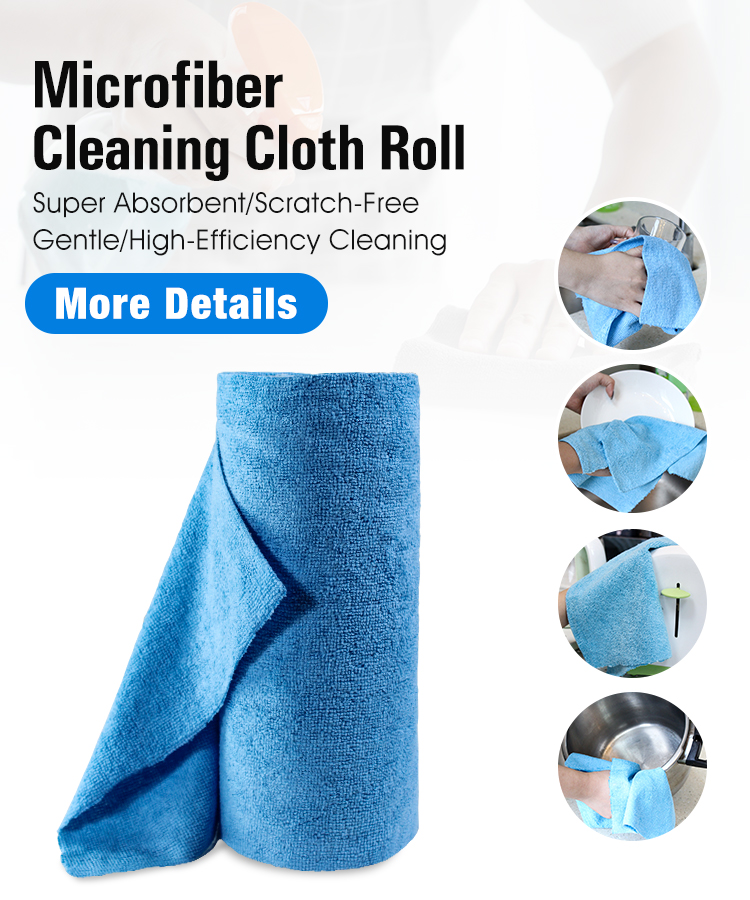
- Microfiber Cleaning Cloth Roll (MJ-012). A perforated tear-off roll in 180–320 gsm, 30×30 cm per sheet. It absorbs up to 7 times its own weight, is lint-free and scratch-free, and is suitable for hotel daily sanitation, stainless steel, and tableware cleaning.
2. Auto Beauty and Car Wash Chains: High-GSM, Scratch-Safe, and Lint-Free
Auto beauty and car wash chain supply projects share the same indoor temperature range and frequent water immersion, but add high-frequency friction and repeated scrubbing. The product role is to wipe surface dust, absorb water, remove stains, and clean car paint. Reusable washing is expected.
- Microfiber Car Wash Towel (MJ-022). A 40×40 cm, 300–500 gsm towel with a single-side long plush terry pile and ultrasonic cut edge without loose thread. It absorbs up to 7 times its own weight, is lint-free, scratch-safe for automotive paint and glass, and machine washable.
- Microfiber Twisted Loop Auto Cleaning Cloth (MJ-030). Available in 100×50 cm or 60×40 cm at 500–1000 gsm. The twisted fiber loop technology and piped binding edge reduce shedding; the cloth is streak-free, water-spot resistant, and scratch-safe for paint and glass.
- Microfiber Chenille Auto Cleaning Mitt (MM-069). A 25×18 cm, 135 g mitt with a double-layer dual-face construction and elastic wrist cuff. It absorbs up to 7 times its own weight of water and car wash foam, and is lint-free, colorfast, and safe for paint, glass, and wheel hubs.
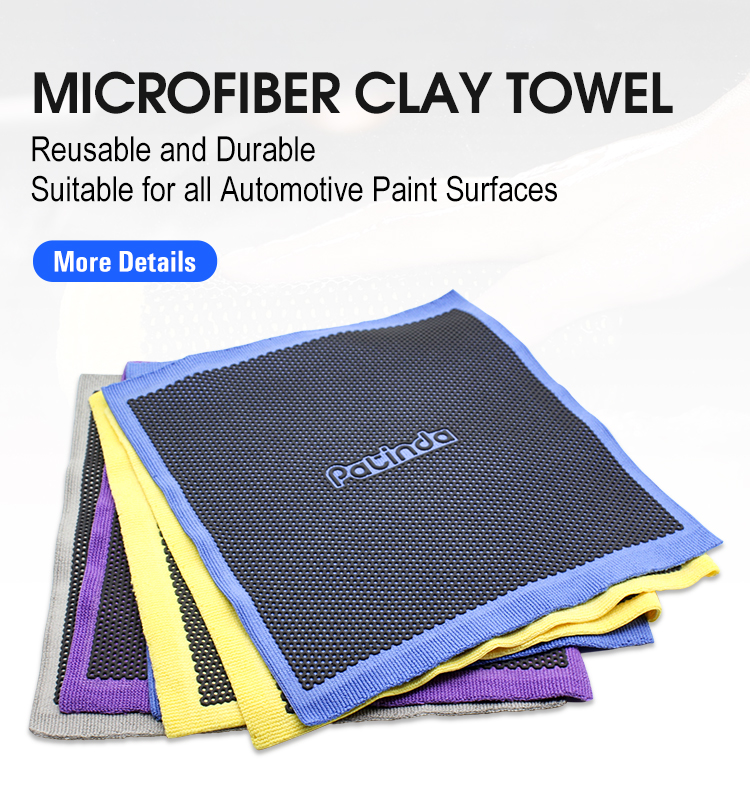
- Microfiber Clay Towel (MM-072). A 30×30 cm, 120 g two-in-one towel. One side uses a rubber-dotted clay surface to remove iron powder, paint speckle, bird droppings, oxidation, and asphalt stains; the reverse terry side absorbs up to 7 times its own weight of water. It is scratch-free for all automotive paint surfaces and reusable after cleaning.
3. Household, Kitchen, and Glass: Quick-Dry, Oil-Removing, and Streak-Free
The household segment is the largest use category in the market, and it includes kitchen, furniture, appliance, and glass maintenance. The working conditions are less extreme than commercial cleaning, but the product must handle grease, frequent washing, and fast drying.
- Microfiber Fancy Kitchen Towel (MS-074). A 60×40 cm waffle checkered towel in 200–400 gsm. The mini waffle grid structure dries quickly, stays lint-free, and provides non-abrasive cleaning that remains durable after repeated washing.
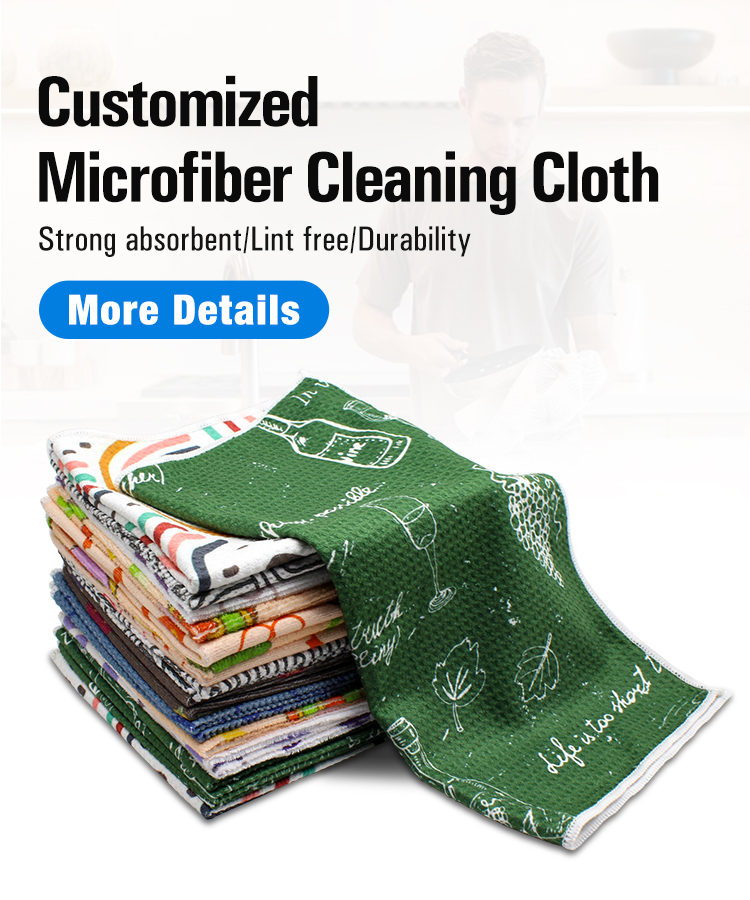
- Customized Microfiber Cleaning Cloth (MS-075). A 40×40 cm waffle honeycomb weave cloth with strong water absorbency and a double-stitched edge. It supports custom printing patterns, Pantone color, logo, and packaging, making it a common choice for branded household cleaning programs.
- Microfiber Bamboo Fiber Cloth (MW-003). A striped kitchen dish cloth blended from 60% polyester, 20% polyamide, and 20% bamboo fiber. It is described as antibacterial and odorless, with strong detergency, and remains non-greasy and soft after long-term use.
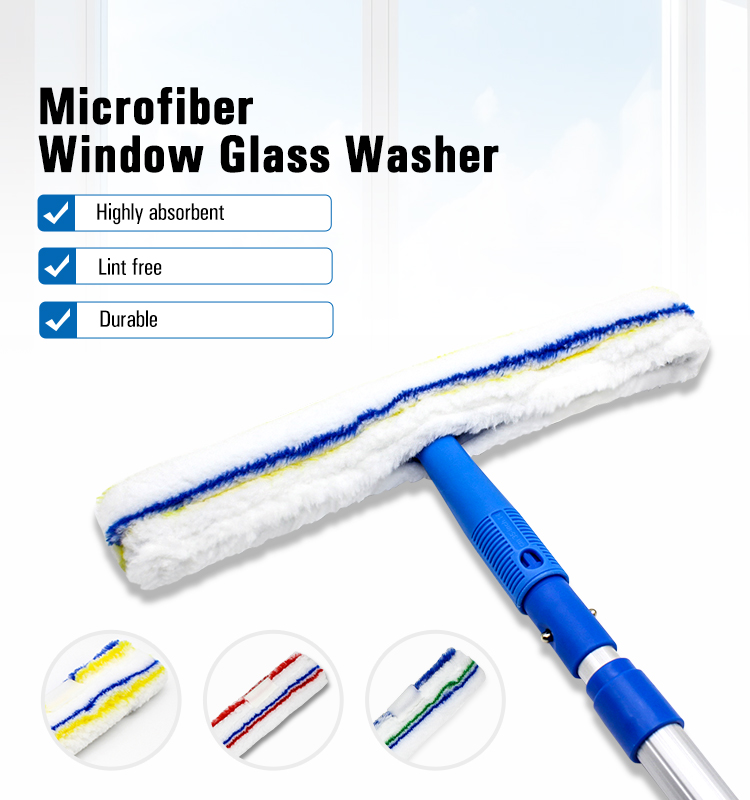
- Microfiber Glass Cleaning Cloth (MJ-013). A 40×40 cm fine rib weave cloth, available in 180–320 gsm, with 10–12 stitches per inch double overlock stitched edge. It works dry or wet, leaves no lint residue and no water marks, and removes grease and water stains from glass, mirrors, LCD screens, and tableware.
- Microfiber Premium Polishing Cloth (MW-002). A 50×40 cm circular-knitted cloth with a scalloped laser cut edge, in 200–240 gsm. It polishes glass, stainless steel, and screens without chemicals, and is lint-free, streak-free, and scratch-free.
- PVA Microfiber Cleaning Cloth (PVA-002). A PVA-coated wiping cloth in 38×35 cm with a die-cut finished edge. It provides high water absorption, streak-free wiping, and strong oil and stain removal; it becomes soft after soaking in water.
Step-by-Step: How to Match a Microfiber Product to Your Project
Step 1. Define the working environment
Record whether the product will be used indoors, the expected temperature, how often it will be immersed in water, how long it takes to dry, and how much friction and scrubbing it will face. The project scenarios above show that indoor environments at 10°C–35°C with frequent wet-dry cycling are common, but a project with outdoor use or chemical exposure needs a different specification.
Step 2. Prioritize the primary function
Select the dominant job: water absorption after a car wash, grease removal in a kitchen, dust and hair capture on a floor, or streak-free polishing of glass. For high water absorption, use twisted-loop or terry structures with 7x absorbency claims. For oil removal, use PVA, bamboo, or waffle structures. For polishing, use fine-weave or circular-knitted cloths.
Step 3. Select material, structure, and edge treatment
Check the fiber ratio. Most of Pa Tin Da's cloths use 80% polyester / 20% polyamide; some use 85/15, and others blend bamboo fiber, nylon, cotton, PU, PVA, or acrylic for specific functions. Structure choices include warp-knitted terry, circular (weft) knitting, twisted loop, chenille, coral fleece, waffle honeycomb, and fine rib weave. When lint is unacceptable, choose ultrasonic sealed or laser cut edges; when heavy washing is expected, choose double-stitched or overlock edges.
Step 4. Verify reuse and hygiene requirements
Commercial projects should confirm the number of washing cycles. For example, the Microfiber Stripe Mop (MP-014) is rated reusable over 300 washing cycles. Quick-dry is a stated requirement in hotel procurement, and color-coded pads support hygienic zoning in hospitals and hotels. Confirm that the product is machine washable and that repeated washing does not change dimensions or absorbency.
Step 5. Lock customization and compliance
Pa Tin Da Group Co., Ltd. operates OEM/ODM production with customization covering size, weight, logo, material, fabric texture, printing, color, accessories, packaging, extra functional requirements, shipping label, and GSM. The standard MOQ is 3,000 pieces, monthly capacity is 182,022 kg, and lead time is 30–45 days. Quality control includes 100% testing, and after-sales service is available. If the project requires OEKO-TEX Standard 100 or GRS, verify the certificate during the supplier audit.
Use Cases in Practice
Hotel and resort sanitation procurement in Germany
In Germany, this product category is commonly used in hotel and resort daily sanitation procurement projects. The operating mode is reusable daily use with repeat washing. The buying team requires custom logo, custom size and color, quick-dry, lint-free, and high water absorbency. Matching products include the Universal Cleaning Cloth (MJ-002), Terry Wet Mop (MT-003), Stripe Mop (MP-014), Abrasive Mop (MP-020), and Cleaning Cloth Roll (MJ-012), all of which can be produced with custom labels, colors, and packaging.
Auto beauty and car wash chain supply
In auto beauty and car wash chain supply projects, the product must wipe surface dust, absorb water, remove stains, and clean car paint under frequent water immersion and scrubbing. A typical mix combines the Car Wash Towel (MJ-022) for contact drying, the Chenille Auto Cleaning Mitt (MM-069) for wash foam, the Twisted Loop Auto Cleaning Cloth (MJ-030) for final buffing, and the Clay Towel (MM-072) for paint decontamination.
Distributor, gym brand, and janitorial wholesale buying
Retail distributors, auto care brands, gym brands, and janitorial wholesalers order roughly 1,000–50,000 pieces per order. Applications include home cleaning, car detailing, gym sweat wiping, and commercial cleaning service. Buyers in this group expect a usable life of 6–12 months after repeated washing, with high water absorption, no lint falling, and efficient stain removal. Custom logo, lightweight construction, quick-dry behavior, and durability after hundreds of washes are the most requested features.
Comparison Table: Project Scenario vs. Product Match
| Project Scenario | Working Conditions | Product Structures | Example Models | Sourcing Priorities |
|---|---|---|---|---|
| Hotel and Resort Sanitation | Indoor 10°C–35°C; frequent immersion; repeated wet-dry cycles; high-frequency scrubbing | Terry loop strip, striped nylon pile, abrasive stripe, tear-off roll | MT-003, MP-014, MP-020, MJ-012 | Custom logo and color, quick-dry, lint-free, high absorbency, reusable |
| Auto Beauty and Car Wash | Indoor 10°C–35°C; frequent immersion; scrubbing; paint and glass surfaces | Twisted loop, long plush terry, chenille mitt, rubber-dotted clay towel | MJ-022, MJ-030, MM-069, MM-072 | Scratch-safe, lint-free, high GSM, 7x water absorption |
| Household and Kitchen | Daily grease; frequent washing; quick-dry needed | Waffle checkered, waffle honeycomb, bamboo blend, PVA coated | MS-074, MS-075, MW-003, PVA-002 | Oil removal, easy wash, antibacterial option, custom print |
| Glass and Mirror Maintenance | Smooth surfaces; streak-sensitive; both dry and wet use | Fine rib weave, circular-knitted polishing, glass washer sleeve | MJ-013, MW-002, CG-002 | No lint, no water marks, scratch-free |
FAQ
What certifications should microfiber cleaning products for hotel or household projects meet?
OEKO-TEX Standard 100 is the dominant safety certification for microfiber textiles, requiring testing against more than 1,000 harmful substances. For projects with recycled-content targets, GRS requires a minimum of 20% recycled content and traces the entire production chain. In project procurement, request the manufacturer's current certificate and confirm which production stage and materials it covers before mass production.
Can Pa Tin Da Group Co., Ltd. produce custom microfiber cleaning products for different project scenarios?
Yes. Pa Tin Da Group Co., Ltd., founded in 2004, operates OEM/ODM production. Customization covers size, weight, logo, material, fabric texture, printing, color, accessories, packaging, extra functional requirements, shipping label, and GSM. The factory in Foshan has a 45,000 m² plant, more than 450 machines, 10+ fully automatic production lines, and around 200 employees including 17 engineers.
What factors determine the budget for project-based microfiber cleaning products?
Unit cost depends on specification. GSM, size, fiber blend, edge finish, logo method (woven label, printed, or embossed), packaging format, and order quantity all affect price. A terry wet mop refill at 200 g or 300 g and a twisted-loop auto cloth at 500–1000 gsm sit in different price ranges because material weight and process differ. The standard MOQ for OEM projects is 3,000 pieces, so budget planning should start from the full specification, not a single unit price.
How can I evaluate samples before a bulk project order?
Define acceptance criteria before sampling: size, GSM, water absorbency, lint resistance, edge durability after washing, logo placement, and packaging. Contact Pa Tin Da's sales team at sale@microfiberchina.com to confirm sample availability and evaluation support. A pre-production sample check is the normal step before an OEM order, especially when the order includes custom color, label, and packaging.
What is the lead time for an OEM microfiber cleaning products project?
The standard lead time is 30–45 days. Monthly capacity is 182,022 kg, and quality control includes 100% testing. For seasonal peaks, confirm capacity early in the project plan. After-sales service is available. To start a project conversation, contact the sales team by email at sale@microfiberchina.com or by WhatsApp/Tel at +86 13902254847.
Conclusion
Specifying microfiber cleaning products by project conditions is a repeatable process: define the environment, prioritize the function, select the structure, verify reuse and hygiene, then lock customization and compliance. This approach reduces the risk of lint, early wear, and poor cleaning results, and it creates a clear basis for comparing supplier proposals.
Pa Tin Da Group Co., Ltd. exports approximately 98% of its output to markets including the USA, Canada, Australia, the UK, Germany, France, Italy, the Netherlands, Russia, Japan, Korea, Switzerland, Sweden, Turkey, and Saudi Arabia. For project planning, the factory can provide OEM/ODM support, custom labeling, and a dedicated contact for specification review.

Planning a hotel, auto, or household microfiber cleaning project?
Download the company E-catalog or discuss your specification with the factory team.
Download Pa Tin Da E-catalog (PDF)
Email: sale@microfiberchina.com | WhatsApp/Tel: +86 13902254847 | www.microfiberchina.com
Have Questions or Need More Details?
Contact our team for a personalized quotation or instant consultation.
Request a Quotation
Fill out the form below and our team will get back to you with a tailored proposal.
WhatsApp Direct Chat
Prefer to chat in real-time? Message us on WhatsApp for instant assistance & quick answers.
- Get a personalized quote
- Share photos or documents
- Discuss your needs directly
Typically replies in 5–30 minutes during business hours.