
Commercial Kitchen Cleaning: A Zone-by-Zone Microfiber Product Guide
A commercial kitchen rarely fails at cleaning because the staff work too little. It fails because one cloth, one mop pad and one color travel from the dish pit to the dining floor to the raw-prep line, carrying soil and grease across zones that should never share a tool.
This guide maps microfiber cleaning products to the zones of a commercial kitchen and food-service facility, using only product facts that trace back to verified manufacturer and certificate data. Front-of-house and back-of-house floors are covered by two mop pads: the MP-014 Microfiber Stripe Mop (microfiber/nylon blend, color-coded commercial wet/dry pad) for lighter floor soil, and the MP-020 Microfiber Abrasive Mop (microfiber + PET, color-coded dual-purpose dry/wet pad) for production floors that collect grease film and stubborn marks. Dish and surface cleaning is covered by two cloths: the MJ-016 Double Layer Microfiber Dish Cloth (microfiber and PET, 30×30 cm, 28 g) for scrubbing cookware and tableware, and the MD-020 Striped Kitchen Cleaning Cloth (80% polyester/20% polyamide, 30×30 cm or 40×40 cm, GSM 250–350) for counters, prep surfaces and appliance exteriors. Facility managers and distributors can use the construction, size and color-coding logic below to match each product to each kitchen cleaning task.
The short answer for facility managers and distributors:
- Dining and light-traffic floors: MP-014 Microfiber Stripe Mop, 40 cm or 50 cm, 100 g or 115 g.
- Production and grease-heavy floors: MP-020 Microfiber Abrasive Mop, 40 cm or 50 cm, 80 g or 95 g, with a red PET abrasive stripe.
- Dish pit and cookware: MJ-016 Double Layer Microfiber Dish Cloth, 30×30 cm, 28 g, with a PET scouring side and a microfiber absorbent side.
- Prep surfaces and equipment: MD-020 Striped Kitchen Cleaning Cloth, 30×30 cm or 40×40 cm, 250–350 GSM, lint-free and machine washable.
Color coding is the organizing principle. It is what keeps a mop pad inside its own zone.
The Problem: Why One Cloth Cannot Serve a Whole Kitchen
Kitchen microfiber cleaning products are usually bought as a single generic item, but commercial kitchen cleaning is at least three different mechanical jobs, each with its own soil profile.
- Floor soil capture. Food-service floors collect dust, hair, crumbs and a thin grease film. The tool has to trap particles rather than push them, and it has to work both dry and lightly wet.
- Scrubbing plus absorption at the dish pit. Baked-on food, oil and starchy residue need an abrasive face and an absorbent face. A single towel does one of those jobs well and the other badly.
- Lint-free surface finishing. Counters, pass-through shelves, appliance exteriors and stainless steel are judged visually. Any cloth that sheds fiber or leaves streaks creates rework.
When a facility standardizes on one product, it usually buys the wrong construction twice. A soft terry cloth absorbs water well but will not lift baked-on food from a sheet pan. An abrasive surface that is excellent at scrubbing can mark polished stainless steel and is unnecessarily aggressive for a dining-room floor. Meanwhile, using the same mop pad behind the cooking line and in guest areas is exactly the tool movement that zone-based cleaning programs exist to prevent.
Color coding solves the addressing problem. Both mop pads described here carry a classification feature on the back: the MP-014 has a color-coded classification tag, and the MP-020 has a four-color classification label for area management. A distributor or facility manager can assign one color per zone – dining, production, dish pit, restrooms – and staff no longer have to guess which tool belongs where. The same logic applies to cloths: MJ-016 and MD-020 both accept custom colors and logos, so the dish pit cloth and the surface cloth can be physically different colors on the same shelf.
Four decisions determine the outcome before any order is placed: the zone list, the dominant soil type in each zone, the working width of the pad, and the color code assigned to it. Everything else – GSM, fabric face, edge stitching – follows from those four.
Industry Background: What Microfiber Changed in Food-Service Cleaning
Microfiber became the default material in professional cleaning for measurable reasons rather than marketing reasons. Dataintelo values the global microfiber cleaning cloth market at approximately USD 3.8 billion in 2025 and projects USD 27.5 billion by 2034. Published estimates for the same market diverge widely, because some studies count only retail household products while others include institutional and industrial segments, so any single figure should be read as a segmentation choice rather than a fixed market size. On the supply side, Volza records 10,544 microfiber towel shipments from China between June 2024 and May 2025, which supports China's position as the largest exporter of microfiber towels.
The operational case is also documented. Global Growth Insights reports that microfiber products reduce chemical usage by up to 60% and water consumption by up to 90% compared with traditional cleaning tools. For a kitchen running several hundred covers a day, water and chemical reduction is an operating-cost line, not a marketing line.
Certification is the third shift in buyer behavior. OEKO-TEX Standard 100 – the dominant safety certification for microfiber textiles – requires testing against more than 1,000 harmful substances. The Global Recycled Standard requires a minimum of 20% recycled content and tracks the entire production chain. Buyers in food service increasingly request these documents before they discuss price, because they carry the compliance risk of the facility they supply.
Manufacturing capacity matters as well, since kitchen cloths and mop pads are a volume category with predictable replacement cycles. Foshan Patinda Housewares Co., Ltd. is a microfiber manufacturer established in 2004, operating a 45,000 m² plant with 200 employees, a 17-engineer R&D team and a 98% export ratio. Its main markets include the USA, Canada, Australia, the UK, Germany, France, Italy, the Netherlands, Russia, Japan, South Korea, Switzerland, Sweden, Turkey and Saudi Arabia. Monthly production capacity is 182,022 kg, typical production lead time is 30–45 days, and the minimum order quantity is 3,000 pieces.
Product Mapping: Which Microfiber Product Belongs in Which Zone
Each product below is defined by the construction that determines where it belongs. Read the material and the working face first; size, weight and color code are downstream decisions.
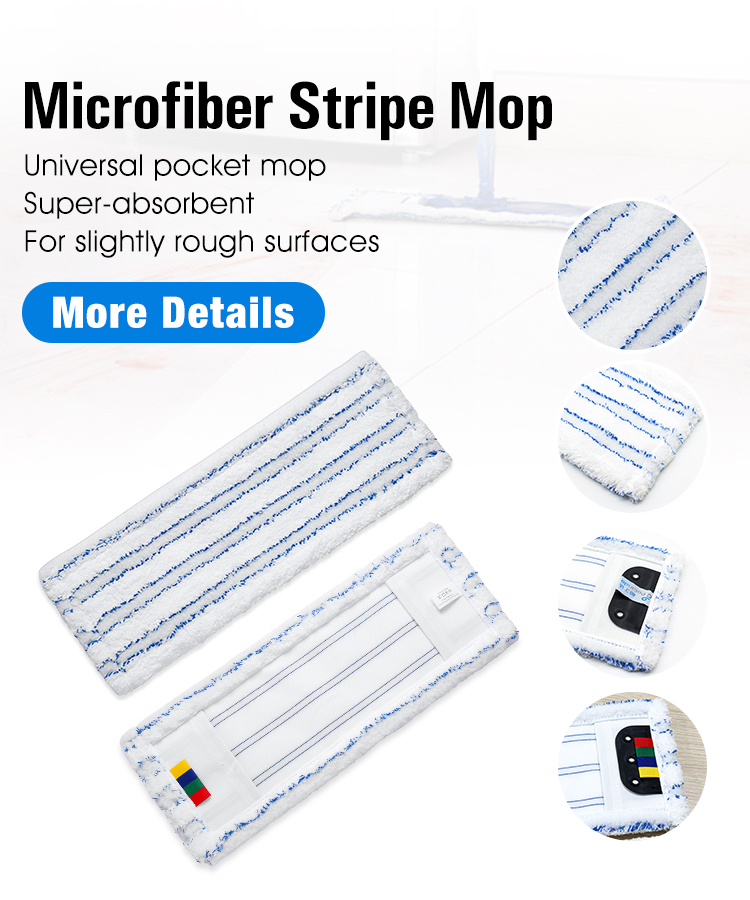
Front-of-House and Light-Soil Floors: MP-014 Microfiber Stripe Mop
The MP-014 is a color-coded commercial wet/dry floor cleaning mop pad. Its front surface is a mixed microfiber and nylon striped pile, which is the part that captures rougher floor dirt; the back uses a double pocket fixing design with a color-coded classification tag. Standard sizes are 40 cm and 50 cm, with customizable sizes available, and single-piece weights of 100 g or 115 g.
Performance data for this pad states that it absorbs up to 7 times its own weight in liquid, picks up more dust than a regular mop, and remains reusable over 300 washing cycles. It is suitable for marble, hardwood and ceramic tile in both dry and wet cleaning. That combination defines its zone: dining rooms, entrances, corridors, guest restrooms and other front-of-house areas where the soil load is dust, crumbs and light foot traffic rather than heavy grease. In these areas, appearance is the acceptance criterion, so a pad that captures dust without smearing and can be re-launched wet for spot work is more useful than an aggressive scrubbing pad.
Back-of-House Floors: MP-020 Microfiber Abrasive Mop
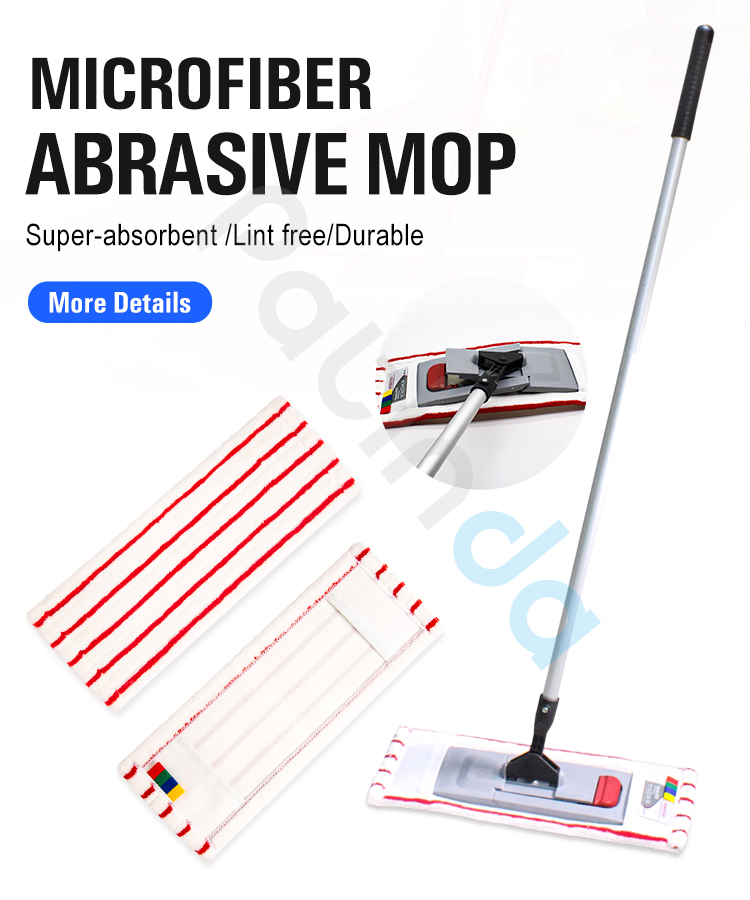
The MP-020 is a color-coded commercial dual-purpose dry and wet floor cleaning mop pad. Its construction is deliberately split: a white microfiber main pile does the absorbing and dust capture, while a red PET abrasive stripe handles stubborn stain removal. The back uses a double pocket fixing design with a four-color classification label intended for area management. Standard sizes are 40 cm and 50 cm, with customizable sizes optional, and single weights of 80 g or 95 g.
Its stated performance is strong dust and hair capture, high water absorption, and scratch-free results on marble, hardwood and ceramic tile. It is reusable after repeated washing and is positioned for commercial hygienic graded cleaning. This is the pad for production floors and the areas around the dish pit, waste handling and cooking lines, where a thin grease film and tracked soil build up and where a plain absorbent pad would simply redistribute the film. The abrasive stripe provides mechanical action without requiring a separate scrub tool, and the four-color label lets a facility separate, for example, a red-coded dish-pit pad from a blue-coded production-floor pad even when both are the same model.
Dish Pit and Cookware: MJ-016 Double Layer Microfiber Dish Cloth
The MJ-016 is a double-sided scouring kitchen cleaning cloth with a double-layer design. One side is a PET mesh for stain scrubbing; the other side is microfiber for water absorption. Each piece weighs 28 g, the standard size is 30×30 cm with customizable sizes available, and the edge is finished with high-density stitching. Stated features include easy oil stain removal and usability for both wet and dry cleaning. Color, logo and packaging are customizable.
For facility managers, the double-layer structure is the specification that matters. Warewashing and cookware cleaning require two mechanical actions in sequence: breaking down baked-on or oil-bound residue, then absorbing the loosened material and leaving the surface dry. A single-face cloth forces staff to switch tools mid-task, which is where shortcuts appear. A double-layer cloth keeps both faces available in one hand movement, and the PET mesh side gives the abrasive action needed on sheet pans, pots and grill components without scratching the way steel wool or metal scrapers can.
Prep Surfaces, Counters and Appliance Exteriors: MD-020 Striped Kitchen Cleaning Cloth
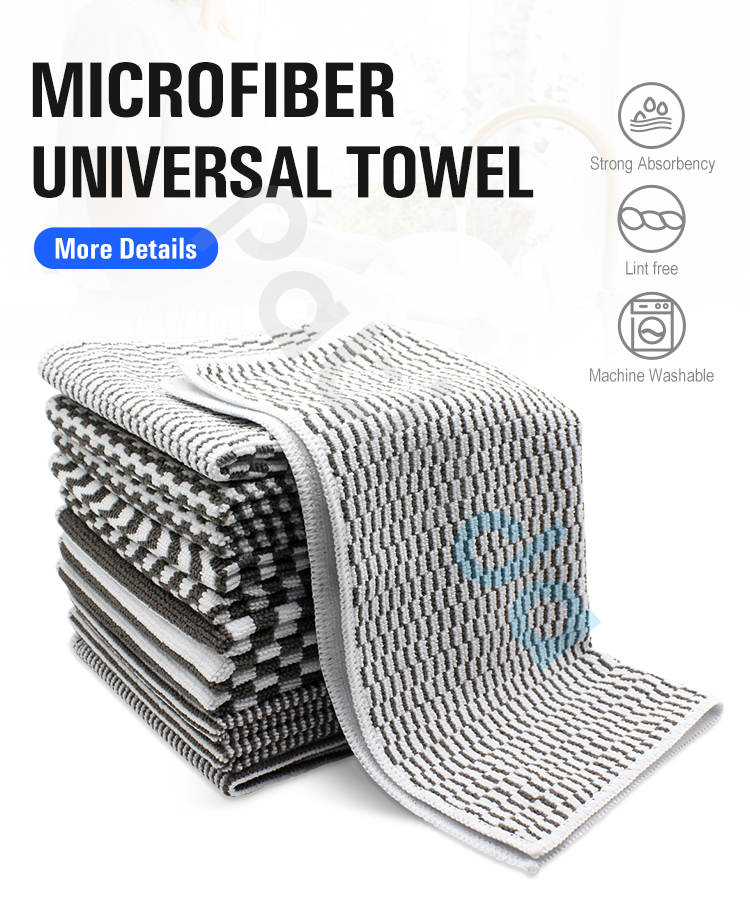
The MD-020 is a striped kitchen cleaning cloth made from 80% polyester and 20% polyamide, with a GSM range of 250–350. Standard sizes are 30×30 cm and 40×40 cm, with customizable sizes available. It absorbs up to 7 times its own weight in liquid, uses a 10–12 stitches per inch high-density locking edge, and is described as lint-free and machine washable. Multiple striped weave patterns are available, and color, logo and package can be customized.
The 250–350 GSM range places this cloth in a mid-weight territory that suits surface work: heavy enough to hold water and wipe a counter in one pass, light enough to rinse and wring quickly during a service shift. Lint-free construction and a locking edge matter at the pass-through and on appliance exteriors, where fiber residue is the main reason a surface has to be wiped twice. Striped weave patterns are also practical in a shared kitchen: a specific stripe acts as a visual identifier when a facility prefers pattern coding alongside color coding.
Step-by-Step: Building a Zone-by-Zone Kitchen Microfiber Kit
The kit is built in six decisions, in this order. Changing the order usually leads to buying products before the zones are defined.
- Map the zones. List every area in the facility and assign each one to a hygiene level: guest-facing (dining, entrance, restrooms), production (prep, cooking line, warewashing surrounds) or high-soil (waste handling, floor drains, receiving). A commercial kitchen of any size will usually produce three to five zones.
- Assign one color per zone. Use the classification tag on the MP-014 and the four-color classification label on the MP-020 to bind each pad to a zone for area management. Apply the same logic to cloths through customized colors on MJ-016 and MD-020.
- Match construction to soil. Dust and hair on light-traffic floors: MP-014 with its microfiber and nylon striped pile. Grease film and stubborn marks on production floors: MP-020 with its red PET abrasive stripe. Baked-on food on cookware and tableware: MJ-016 with its PET mesh scrubbing side. Water and light oil film on counters and equipment: MD-020 at 250–350 GSM.
- Size the tool to the task. Mop pads are selected at 40 cm or 50 cm depending on aisle width and traffic; cloths at 30×30 cm for detailed and dish work, and 40×40 cm for counters, pass-through areas and large surface runs.
- Standardize wash parameters. MD-020 is stated as machine washable. MP-014 is reusable over 300 washing cycles. MP-020 is reusable after repeated washing. Keeping zone colors washed and stored separately is what preserves the coding system over time.
- Lock the specification and then scale. Convert the zone map into a written purchase specification: model, size, weight or GSM, fabric face, edge type, color and packaging. That specification is the document the manufacturer quotes against and the document staff are trained on.
Use Cases: How the Zone Map Plays Out in Real Facilities
Quick-service restaurant with a combined dining and production floor. A single 50 cm MP-014 pad covers the dining area and the front counter zone in dry mode during service and wet mode at close, and a 40 cm MP-020 pad stays behind the line for the grease film around the fryer and the dish return. Two pads, two colors, no tool movement between zones.
Hotel or contract catering production kitchen. The production floor is the dominant soil source, so MP-020 pads in both 40 cm and 50 cm are used with the four-color label to separate cooking line, warewashing surrounds, walk-in access and receiving areas. MD-020 cloths in 40×40 cm handle pass-through shelves and appliance exteriors where lint-free finishing is the visible acceptance criterion.
Warewashing and dish pit. MJ-016 at 30×30 cm and 28 g per piece is the working cloth at the sink: the PET mesh side breaks down baked-on residue on sheet pans and pots, the microfiber side dries the item before it goes back on the rack. Color customization keeps the dish-pit cloth visually distinct from surface cloths used elsewhere.
Janitorial wholesalers and distributors building an assortment. The four models cover the floor and surface tasks that commercial cleaning customers buy repeatedly, and both mop pads and both cloths accept custom colors, logos and packaging. Order quantities in past programs for retail distributors, auto care brands, gym brands and janitorial wholesalers have ranged from 1,000 to 50,000 pieces per order, with clients in more than 20 countries including Australia, Austria and Belgium.
Comparison Table: Product-to-Zone Matching
| Product and model | Construction | Size and weight / GSM | Color-coding feature | Primary kitchen zone | Reuse and care |
|---|---|---|---|---|---|
| Microfiber Stripe Mop – MP-014 | Microfiber + nylon blended fabric; front mixed microfiber and nylon striped pile; back double pocket fixing | 40 cm / 50 cm (customizable); 100 g / 115 g per piece | Color-coded classification tag | Front-of-house floors and light-soil back-of-house floors: marble, hardwood, ceramic tile, dry and wet | Absorbs up to 7 times own weight; reusable over 300 washing cycles |
| Microfiber Abrasive Mop – MP-020 | Microfiber + PET blended fabric; white microfiber main pile + red PET abrasive stripe; back double pocket fixing | 40 cm / 50 cm (optional customization); 80 g / 95 g per piece | Four-color classification label for area management | Production floors, cooking line and dish-pit surrounds; stubborn stains and grease film on marble, hardwood, ceramic tile | High water absorption; reusable after repeated washing; scratch-free on stated floor types |
| Double Layer Microfiber Dish Cloth – MJ-016 | Microfiber / PET; double-layer, double-sided: PET mesh scrubbing side plus microfiber absorbent side | 30×30 cm (customizable); 28 g per piece | Customizable color, logo and packaging for zone identification | Dish pit, cookware, tableware, warewashing area; wet and dry use | High-density edge stitching; easy oil stain removal |
| Striped Kitchen Cleaning Cloth – MD-020 | 80% polyester / 20% polyamide; striped weave with multiple patterns available | 30×30 cm or 40×40 cm (customizable); GSM 250–350 | Customizable color and multiple striped weave patterns | Prep counters, pass-through, tableware wiping, appliance and surface cleaning | Absorbs up to 7 times own weight; lint-free; machine washable; 10–12 stitches per inch locking edge |
Compliance and Documentation to Verify Before You Commit
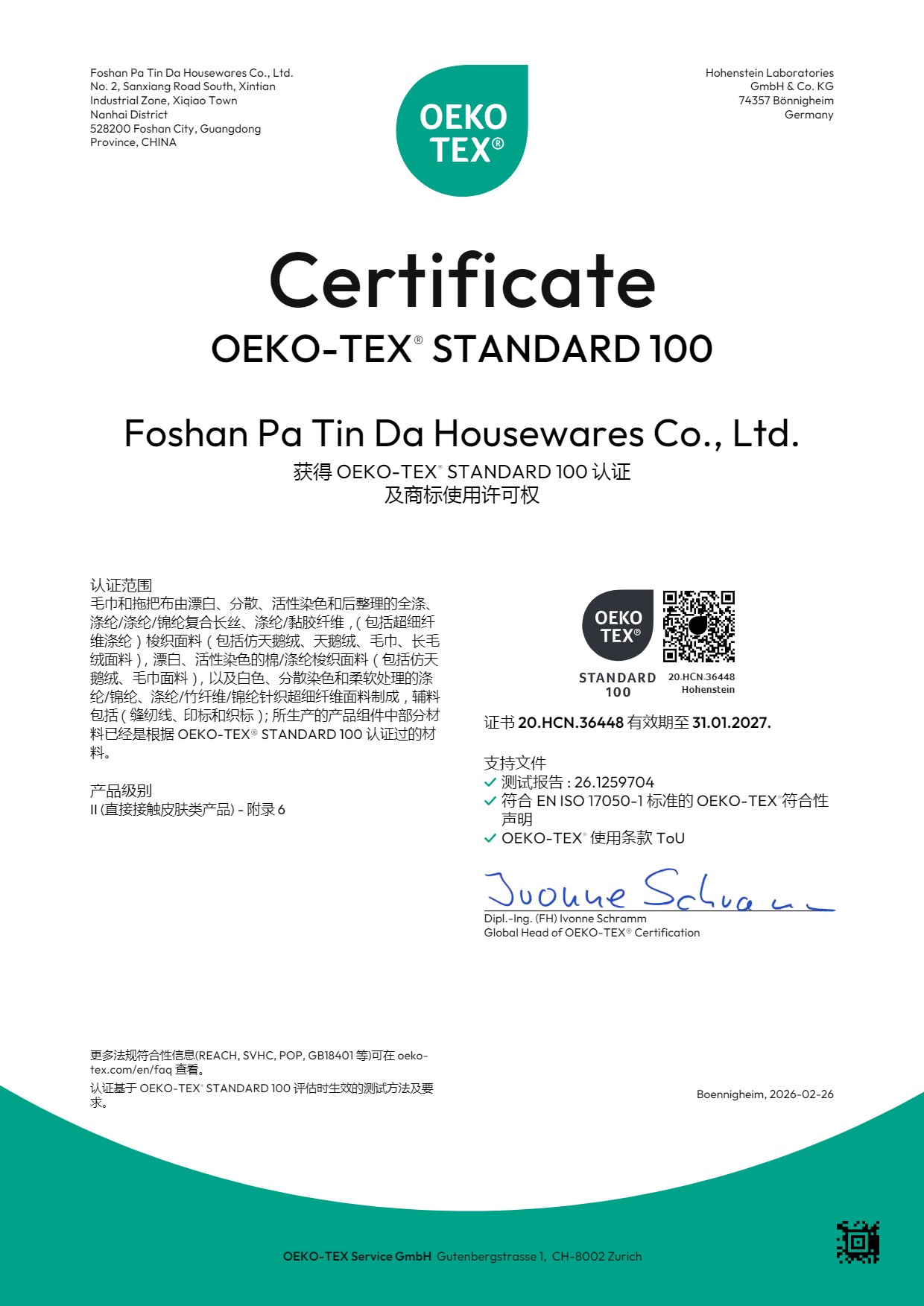
For food-service buyers, the product specification is only half of the evaluation. The other half is documentation that can be shown to an auditor or a corporate customer. The four products in this guide appear on the related product lists attached to the manufacturer's certification records, which means they can be referenced by model number when documents are requested.
| Certification | Scope / standard reference | Issuing body | Certificate number | Validity |
|---|---|---|---|---|
| OEKO-TEX STANDARD 100 | Product Class II – Annex 6 | Hohenstein Laboratories GmbH & Co. KG | 20.HCN.36448 | Issued 26 February 2026; valid to 31 January 2027 |
| ISO 9001:2015 | Manufacture of towels and mops | SGS United Kingdom Ltd | CN24/00007747 | Issued 8 December 2024; valid to 7 December 2027 |
| ISO 45001:2018 | Manufacture of towels and mops | SGS United Kingdom Ltd | CN24/00007748 | Issued 8 December 2024; valid to 7 December 2027 |
| SMETA (Sedex Members Ethical Trade Audit) | 4-Pillar: labour standards, health and safety, environment, business ethics (ETI Base Code) | Benchmarks Company Limited | ZAA600123152 | Issued 3 April 2025 |
| German Packaging Act (VerpackG) registration | Manufacturer of product-filled packaging pursuant to § 9 VerpackG, LUCID register | Stiftung Zentrale Stelle Verpackungsregister | DE3922560298890 | Issued 17 May 2023 |
| French REP Textile UIN | Textiles, France REP Textile Regulation | EUREP GmbH | FR337512_11LKPC | Issued 1 January 2025 |
Two points matter when these documents are used in a tender or a distributor catalog. First, certification applies to the defined scope – here, the manufacture of towels and mops – so the product model numbers should be quoted from the related product lists rather than assumed. Second, packaging compliance registrations for Germany and France are increasingly requested by European buyers because they place obligations on the party that fills or imports the packaging, not only on the producer.
FAQ: Commercial Kitchen Microfiber Products
Which certifications should a food-service buyer verify before ordering commercial kitchen microfiber products?
The four products in this guide – MP-014, MP-020, MJ-016 and MD-020 – appear on the related product lists of the manufacturer's certification records. Those records include OEKO-TEX STANDARD 100 certificate 20.HCN.36448 (Hohenstein Laboratories GmbH & Co. KG), Product Class II – Annex 6, issued 26 February 2026 and valid to 31 January 2027; ISO 9001:2015 certificate CN24/00007747 and ISO 45001:2018 certificate CN24/00007748, both issued by SGS United Kingdom Ltd with the scope manufacture of towels and mops and valid to 7 December 2027; and a SMETA 4-Pillar audit, ZAA600123152, issued by Benchmarks Company Limited on 3 April 2025, covering labour standards, health and safety, environment and business ethics. For European distribution the manufacturer also holds a German Packaging Act registration (DE3922560298890, LUCID register) and a French REP Textile UIN (FR337512_11LKPC, EUREP GmbH). OEKO-TEX STANDARD 100 testing covers more than 1,000 harmful substances, which is why food-service buyers usually treat it as the baseline textile document.
Can mops and kitchen cloths be customized for a specific facility’s color-coding, size and GSM requirements?
Yes. The manufacturer provides OEM and ODM production, and customization covers size, weight, logo, material, fabric texture, printing, color, accessories, packaging, extra functional features, shipping label and GSM. Applied to this guide: MP-014 and MP-020 pads are available in 40 cm and 50 cm with customizable color, woven label and printed logo; MJ-016 is a 30×30 cm, 28 g double-layer cloth with customizable color, logo and packaging; MD-020 is supplied in 30×30 cm or 40×40 cm at 250–350 GSM with customizable color, logo and package, plus multiple striped weave patterns. Production runs with 100% testing for quality control, and after-sales service is available.
What are the minimum order quantity, payment and delivery terms?
The minimum order quantity is 3,000 pieces. Available delivery terms are EXW, FOB, CIF, DAP and DDP. Payment terms are 30/70 T/T, credit or debit card, Apple Pay and Google Pay, and the stated acceptance criterion is pre-shipment testing. For planning reference, past programs for retail distributors, auto care brands, gym brands and janitorial wholesalers have ranged from 1,000 to 50,000 pieces per order, supported by a monthly production capacity of 182,022 kg.
How can a facility manager validate pad and cloth construction before committing to a bulk order?
Validation is done at specification level before it is done at volume. Because 100% testing is applied and pre-shipment testing is the stated acceptance criterion, the practical step is to approve a written specification first: model, fabric blend, working face, size, weight or GSM, edge construction and color code. For the products in this guide, that means confirming MP-014 (microfiber and nylon striped pile, 40/50 cm, 100 g/115 g), MP-020 (white microfiber main pile with red PET abrasive stripe, 40/50 cm, 80 g/95 g), MJ-016 (double-layer microfiber and PET, 30×30 cm, 28 g) and MD-020 (80% polyester / 20% polyamide, 250–350 GSM). Samples and quotations against a specific zone list can be requested directly from the manufacturer at sale@microfiberchina.com.
What lead time and production capacity should be planned for a kitchen microfiber program?
Typical production lead time is 30–45 days, with a monthly production capacity of 182,022 kg. Because color coding, pad width, weight and GSM have to be fixed before cutting and sewing, most schedule risk sits in specification approval rather than in production. Facilities converting from mixed cleaning tools to a zoned microfiber kit should finalize the zone-to-color map and the model list before placing the order, then treat the approved specification as the acceptance document for pre-shipment testing.
Conclusion: Fix the Zone Map First, Then the Product List
A zone-by-zone microfiber program works because it removes decisions from the staff at the moment of cleaning. Dining floors and light-traffic areas get the MP-014 Microfiber Stripe Mop with its microfiber and nylon striped pile and color-coded classification tag. Production floors and dish-pit surrounds get the MP-020 Microfiber Abrasive Mop with its red PET abrasive stripe and four-color area label. The dish pit gets the MJ-016 Double Layer Microfiber Dish Cloth, where a PET mesh side and a microfiber side handle scrubbing and drying in one tool. Counters, pass-through areas and appliance exteriors get the MD-020 Striped Kitchen Cleaning Cloth at 250–350 GSM, lint-free and machine washable.
Foshan Patinda Housewares Co., Ltd. has manufactured microfiber cleaning products since 2004 from a 45,000 m² plant with 200 employees and a 17-engineer R&D team, exporting to markets including the USA, Canada, Australia, the UK, Germany, France, Italy, the Netherlands, Russia, Japan, South Korea, Switzerland, Sweden, Turkey and Saudi Arabia. Production runs with 100% testing, 10 or more fully automatic production lines for precision cloth cutting and sewing, and more than 450 sets of production machinery.
The sequence that produces a workable program is consistent: define the zones, assign the colors, match construction to soil, size the tool, lock the specification, and only then scale the order.

Next step for facility managers and distributors
Download the full product catalog: 2024 product e-catalog (PDF)
Send a zone list, pad width and color code to request a sample and quotation: sale@microfiberchina.com
Contact: Olivia Li | Tel / WhatsApp: +86 13902254847 | Website: www.microfiberchina.com
Address: No. 2, South Sanxiang Rd., Xintian Ind. Zone, Xiqiao Town, Nanhai, Foshan, Guangdong, China
Have Questions or Need More Details?
Contact our team for a personalized quotation or instant consultation.
Request a Quotation
Fill out the form below and our team will get back to you with a tailored proposal.
WhatsApp Direct Chat
Prefer to chat in real-time? Message us on WhatsApp for instant assistance & quick answers.
- Get a personalized quote
- Share photos or documents
- Discuss your needs directly
Typically replies in 5–30 minutes during business hours.