
Specifications vs. Certifications: Buying Microfiber Cleaning Products With Confidence
Microfiber cleaning products have become a routine purchase for retailers, distributors, janitorial wholesalers, auto-care brands, and hospitality buyers. But the category name “microfiber” alone does not tell you whether a cloth will dry glass without streaks, survive repeated industrial washing, or meet the compliance documents required for a specific country. For buyers in the Research and Evaluation phase, the useful question is not only “which product looks good” but “which measurable parameters and certifications can be verified before I commit to a large order.”
This guide explains what to check when comparing microfiber cleaning products: fiber composition, GSM, water absorption, edge construction, wash durability, and the certification documents that support supplier claims. It closes with a step-by-step verification checklist, use-case mapping, a product comparison table, and a short FAQ for procurement teams.
The Problem With the Generic Category Label
A purchasing manager can receive two products that are both called microfiber cleaning cloths. One may be a 180–320 gsm fine-weave cloth designed for glass and screen polishing. Another may be a 500–1000 gsm twisted-loop cloth designed for automotive drying. Both can be genuine microfiber products, but their applications, durability, and unit economics are not interchangeable.
When a request for quotation only says “microfiber cleaning products,” suppliers may quote the item closest to their own stock, not necessarily the item that fits the buyer’s intended use. The result is misalignment between price and performance. Comparing price before comparing parameters is therefore risky. The buyer needs a shortlist built on verifiable constraints: material ratio, gram weight, absorbency, edge treatment, test standards, and compliance certificates.
Industry Background: Scale and Fragmentation
The global market for microfiber cleaning cloths is large and still growing. One third-party estimate values the market at approximately USD 3.8 billion in 2025 and projects it to reach USD 27.5 billion by 2034, according to Dataintelo. Another market observation indicates that the household use segment is expected to hold a 40.0% share in 2025. This explains why so many buying projects start with household cleaning cloths, kitchen towels, and general-purpose rags before moving into automotive, glass, and commercial floor-care segments.
China is a major supply source for these products. Trade shipment data from Volza records 10,544 shipments of microfiber towels exported from China between June 2024 and May 2025. Large global brands such as 3M, Freudenberg Group, Toray Industries, and Libman are also active in the microfiber cleaning market. For a buyer, this means both variety and inconsistency. A supplier can look legitimate in a brochure but still send products that behave differently under actual working conditions.
What to Verify: Performance Parameters That Can Be Checked
Foshan Patinda Housewares Co., Ltd., also known as Pa Tin Da Group, is a China-based manufacturer that supplies microfiber cleaning cloths, kitchen towels, mops, glass cloths, and automotive care textiles. A sample product from its range is useful to ground the discussion in real specifications: the model MJ-002 household microfiber cleaning cloth is made of 80% polyester and 20% polyamide, has a warp-knitted terry surface, standard size 30 by 30 cm, fabric weight 300 gsm, net weight approximately 27 grams per cloth, and absorbs up to 7 times its own weight in water. Another model, MJ-001, is composed of 85% polyester and 15% polyamide, with a standard size of 40 by 40 cm, GSM range of 180–450, a double-stitched edge, and a lint-free, non-fading surface. These are the kinds of data a buyer should expect in a product sheet.
Fiber Composition
Most high-performance microfiber cleaning products in this category use a blend of polyester and polyamide. The ratio affects softness, absorbency, durability, and how the fabric behaves on sensitive surfaces. The models above illustrate two common ratios: 85/15 and 80/20 polyester/polyamide. A buyer should not assume that all microfiber is the same; the composition ratio should be stated on the specification sheet.
GSM and Sizing
GSM, or grams per square meter, is one of the most useful numbers in a technical data sheet. It tells you the fabric density. For a household terry cloth, 300 gsm is used in the MJ-002 model. For glass-polishing cloths, a lower-density fine weave is often preferred. According to product specifications in the same portfolio, the Microfiber Glass Cleaning Cloth MJ-013 has a GSM range of 180–320 and a standard 40 by 40 cm size. At the other end, automotive drying cloths can go much higher: the Microfiber Terry Auto Cleaning Cloth MJ-021 is available in 250–500 gsm, while the Microfiber Twisted Loop Auto Cleaning Cloth MJ-030 reaches 500–1000 gsm. These differences are not cosmetic. A cloth that is too light may not absorb enough water for drying; a cloth that is too heavy may not be suitable for fine glass or screen wiping.
Water Absorption
One of the most commonly used performance benchmarks in this category is absorption of up to 7 times the product’s own weight of liquid. That claim appears repeatedly across the product family: MJ-001, MJ-002, MD-020, MJ-030, and several other models are described with this performance level. Some products also claim that they are 4 times more absorbent than cotton, as in the MJ-021 automotive drying towel. When evaluating a supplier, ask whether the claimed absorption ratio is based on a documented test method or simply marketing language.
Lint-Free, Streak-Free, and Scratch-Safe Properties
Microfiber cleaning products intended for automotive paint, glass, mirrors, marble, hardwood, and ceramic tile are usually described as lint-free, streak-free, water-spot resistant, and scratch-safe. For example, the MJ-013 glass cloth is specified to leave no lint residue and no water marks, and the MJ-030 auto cloth is described as streak-free and water-spot resistant. These properties are important for end customers, but they also need to be confirmed under real use. A sample test can reveal whether the edge sheds fibers after washing.
Edge Construction and Sewing Quality
Loose fibers often appear at the cut edge. This is why edge treatment matters. In the product range discussed here, several methods are used: double stitching, high-density locking edges with 10–12 stitches per inch, decorative overlock binding, ultrasonic cut edges, and laser-cut scalloped edges. The MJ-013 glass cloth, for example, has a 10–12 stitches-per-inch double overlock stitched edge. The MJ-012 cleaning cloth roll uses a clean die-cut edge. A buyer sourcing reusable microfiber cleaning products should ask for the exact edge construction because this one detail can influence lint release and service life.
Wash Durability and Reusability
Reusable microfiber cleaning products are expected to survive repeated washing. In this manufacturer’s commercial mop range, the Microfiber Stripe Mop MP-014 is rated as reusable over 300 washing cycles. Other products are described as machine washable and reusable. A case summary from Pa Tin Da also indicates that clients in retail distribution, auto care, gym, and janitorial wholesale sectors have used products for 6–12 months after repeated washing, with highlights such as custom logos, lightweight feel, quick drying, and durability after hundreds of washes.
Certifications and Market-Access Registrations
Certifications serve a different purpose from product parameters. They tell the buyer which quality, safety, ethical, or environmental standards a facility and its products have been audited against. For the microfiber cleaning cloth model MJ-001, the following documents are available: OEKO-TEX STANDARD 100 certification, certificate number 20.HCN.36448, issued by Hohenstein Laboratories GmbH & Co. KG, and applicable globally. The OEKO-TEX STANDARD 100 family requires testing against a broad list of harmful substances. In addition, the manufacture of towels and mops is certified to ISO 9001:2015, certificate number CN24/00007747, and ISO 45001:2018, certificate number CN24/00007748, both issued by SGS United Kingdom Ltd. The same company holds a SMETA Sedex Members Ethical Trade Audit, number ZAA600123152, issued by Benchmarks Company Limited, covering ETI Base Code and SMETA audit requirements. For Germany, the product is registered under the German Packaging Act, VerpackG § 9, with registration number DE3922560298890 in the LUCID register. For France, a REP Textile UIN certificate, FR337512_11LKPC, covers textile products under the French EPR framework.
Important distinction: certifications confirm that a product or production site meets a defined standard. They do not by themselves prove that a specific cloth is perfect for your surface, your cleaning frequency, or your packaging market. Use certifications as a gate, then validate application-specific performance with a sample.
A Reference Supplier for Constraint-Based Evaluation
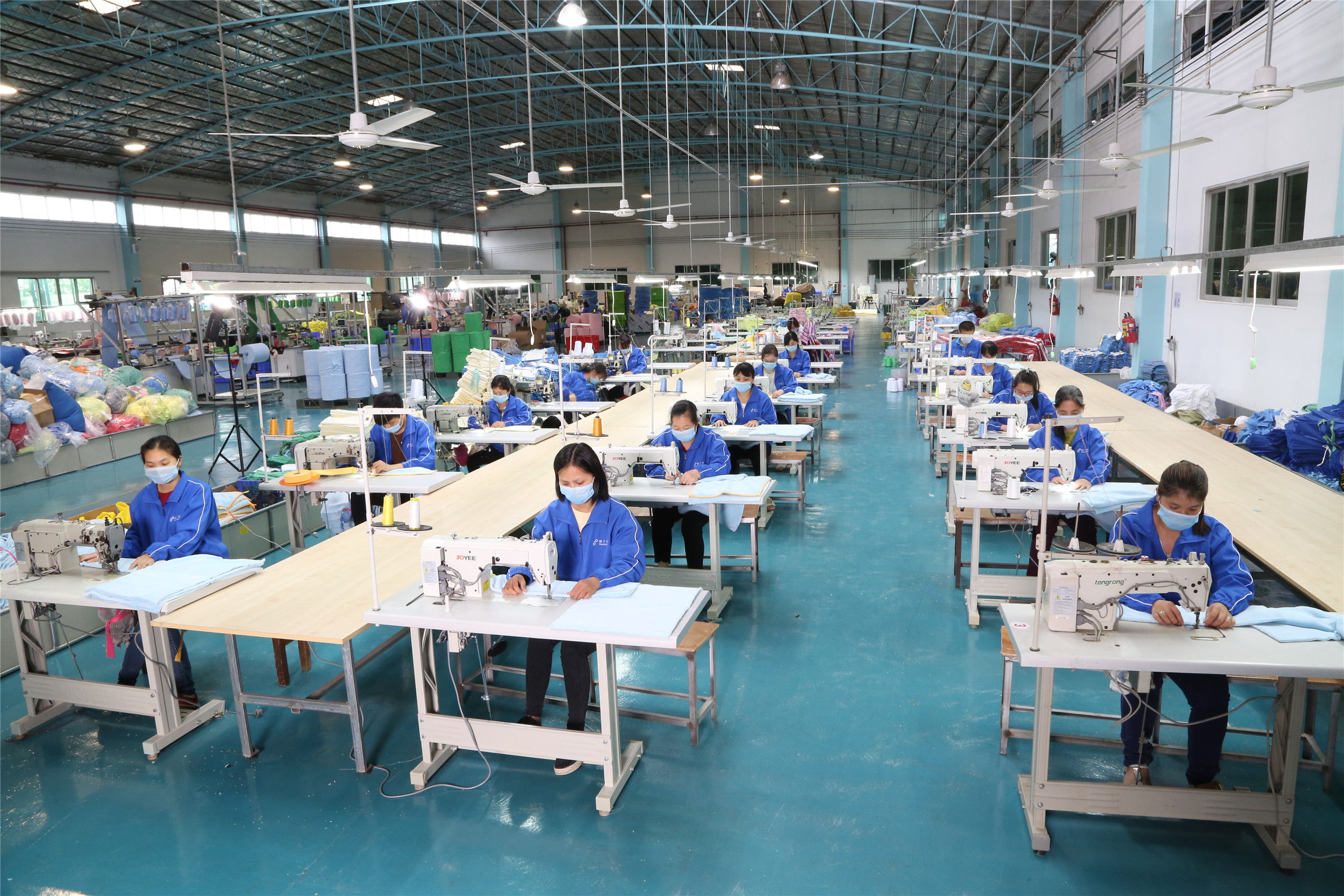
Foshan Patinda Housewares Co., Ltd., based in Foshan, Guangdong, China, is a useful reference because its published capability data aligns with the verification topics above. The company was founded in 2004 and operates a 45,000 m² manufacturing facility. Its export ratio is 98%, with main markets including the United States, Canada, Australia, the UK, Germany, France, Italy, the Netherlands, Japan, South Korea, and other countries. Main products include cleaning cloths, kitchen towels, glass polishing cloths, car washing towels, mops, window washers, and specialized towels. The company lists OEM/ODM production and customization options such as size, weight, logo, material, fabric texture, printing, color, accessories, packaging, GSM, and extra functional requirements. Its published monthly capacity is 182,022 kg, lead time is 30–45 days, MOQ is 3,000 pieces, and quality control is described as 100% testing. This type of information is helpful when a buyer needs to evaluate whether a supplier can handle a sustained bulk program, not just a one-off sample order.
Step-by-Step Verification Process for Buyers
The following process is designed for a team that is shortlisting suppliers of microfiber cleaning products:
- Define the cleaning task, including surface type, soil type, wet or dry use, frequency of washing, and whether lint, streaks, or scratches are unacceptable.
- Set target parameters such as material ratio, GSM range, absorption multiple, edge construction, and minimum wash cycles. For example, a professional car wash may need 250–1000 gsm drying cloths, while a glass maintenance project may prefer 180–320 gsm polished-edge cloths.
- Request a written specification sheet for the exact model quoted. Insist on the model number, composition, GSM, size, single-piece weight, edge type, and absorption data.
- Verify compliance documents by certificate number, issuing body, and applicable market. Check that the documents cover the product category you are buying and the destination country requirements.
- Ask about OEM/ODM constraints before sample approval: MOQ, lead time, monthly capacity, available colors, logo application, and packaging options.
- Test a sample in real working conditions. Wash it, dry it, and use it on the intended surface. Check for lint, streaks, water spots, and edge damage.
- Review production-stage quality control and after-sales service. A supplier that performs 100% testing and offers after-sales service is easier to manage than one that only sends a brochure.
Use-Case Mapping: Where Each Type Fits
Household and Kitchen Cleaning
For daily kitchen wiping and tableware drying, buyers often choose striped or terry-style microfiber towels. The MD-020 Universal Towel, for example, is a striped kitchen cloth with a GSM range of 250–350, a 10–12 stitches-per-inch locking edge, and 7-times water absorption. The MJ-016 Double Layer Microfiber Dish Cloth adds a PET mesh side for scrubbing and a microfiber side for absorption, making it suitable for oil removal and cookware cleaning.
Glass and Mirror Maintenance
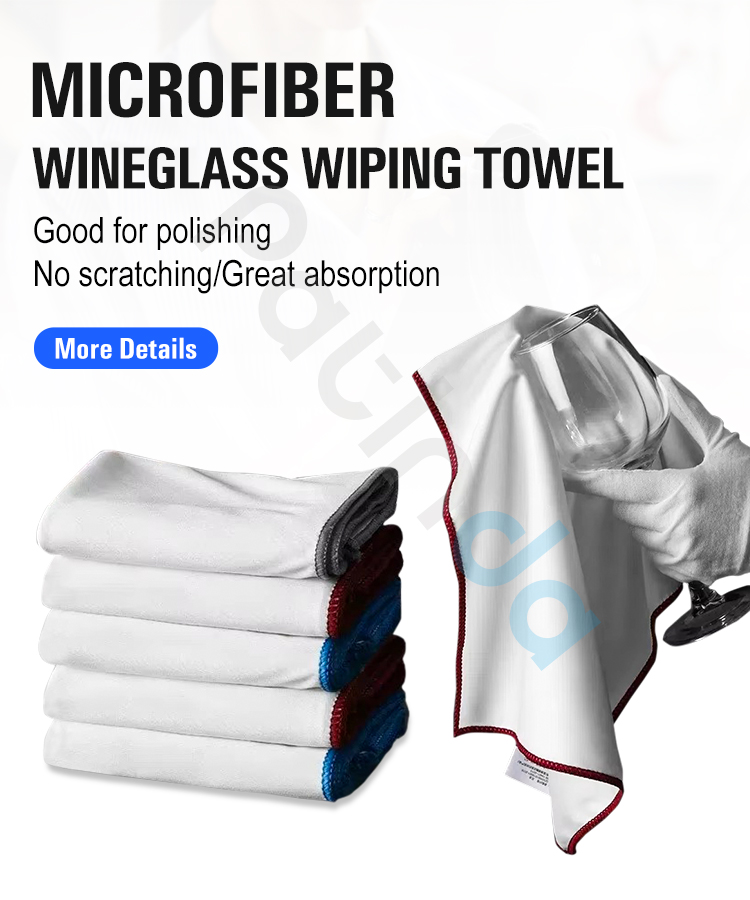
Glass and mirror cleaning requires a cloth that leaves no lint and no water marks. The MJ-013 glass polishing cloth uses a fine rib weave with a 10–12 stitches-per-inch double overlock edge and is designed for dry or wet use. The MW-002 Premium Polishing Cloth, made of 80% polyester and 20% polyamide with a scalloped laser-cut edge, is another product in this application category, intended for glass, stainless steel, and screen maintenance.
Automotive Washing and Detailing
Automotive cleaning products need high absorbency and a surface that will not scratch paint or glass. The MJ-021 Terry Auto Cleaning Cloth is available in 250–500 GSM, absorbs up to 7 times its own weight of liquid, and is described as 4 times more absorbent than cotton. The MJ-030 Twisted Loop Auto Cleaning Cloth goes up to 500–1000 GSM and uses a colorful piped binding edge to prevent fiber shedding. The MM-072 Clay Towel is a two-in-one product: one side has a rubber dotted clay surface for removing contaminants, and the reverse side uses a high-water-absorbent microfiber terry cloth. These products show why a single “microfiber cleaning products” request is not enough when the buyer’s real application is automotive care.
Commercial Floor Care
For hotels, hospitals, restaurants, and commercial property teams, flat mop pads are often selected with color-coding to prevent cross-use between areas. The MP-014 Microfiber Stripe Mop combines microfiber and nylon striped pile for rough-floor dirt capture, has a double-pocket design with a four-color classification tag, absorbs up to 7 times its own weight of liquid, and is reusable over 300 washing cycles. The MP-020 Microfiber Abrasive Mop adds a red PET abrasive stripe for stubborn stains and is also designed for commercial hygienic graded cleaning.
Representative Product Comparison Table
The table below compares product parameters that are stated in the supplier’s published product data. Use it as a template for building your own comparison matrix.
| Model | Primary Application | Material | GSM / Weight | Edge Detail | Key Performance Claim |
|---|---|---|---|---|---|
| MJ-001 | Universal household cloth | 85% polyester / 15% polyamide | 180–450 gsm; 40×40 cm | Double stitched | Lint-free, non-fading, absorbs 7× own weight |
| MJ-002 | Household terry cleaning cloth | 80% polyester / 20% polyamide | 300 gsm; 30×30 cm; approx. 27 g | Double stitching, tidy hem | Warp-knitted terry; absorbs 7× own weight |
| MJ-013 | Glass and screen polishing | 80% polyester / 20% polyamide | 180–320 gsm; 40×40 cm | 10–12 SPI double overlock | No lint residue, no water marks |
| MD-020 | Kitchen / restaurant cleaning | 80% polyester / 20% polyamide | 250–350 gsm; 30×30 or 40×40 cm | High-density locking edge | Machine washable; absorbs 7× own weight |
| MJ-021 | Automotive drying towel | 80% polyester / 20% polyamide terry | 250–500 gsm; 40×40 cm | Decorative overlock binding | 4× more absorbent than cotton; scratch-free |
| MP-014 | Commercial wet/dry floor mop | Microfiber + nylon blended fabric | 40 or 50 cm; 100 g / 115 g | Pocket design with color tag | Absorbs up to 7× own weight; 300+ wash cycles |
Frequently Asked Questions
Which compliance certificates are most relevant when sourcing microfiber cleaning products?
Three categories are commonly used. Product safety: OEKO-TEX STANDARD 100, certificate number 20.HCN.36448, issued by Hohenstein Laboratories GmbH & Co. KG. Management systems: ISO 9001:2015 and ISO 45001:2018, covering the manufacture of towels and mops. Ethical trade: SMETA audit number ZAA600123152, issued by Benchmarks Company Limited. Market-specific registrations may also be required, such as the German Packaging Act registration DE3922560298890 for Germany and the French REP Textile UIN certificate FR337512_11LKPC for France.
What key performance parameters should a buyer verify for microfiber cleaning products?
The most important parameters are material composition, GSM, size, absorption capacity, edge construction, and wash durability. For example, the MJ-002 household cloth is 80% polyester and 20% polyamide, 300 gsm, 30 by 30 cm, and absorbs 7 times its own weight. A different product with the same category name may have a different composition and GSM, which changes its behavior on the intended surface.
Does a higher GSM always mean better performance?
No. GSM should be matched to the cleaning task. Fine-weave glass polishing cloths often use a lighter GSM such as 180–320, while automotive drying towels use heavier fabric in the range of 250–500 or even 500–1000 gsm. A heavier cloth is not automatically better for all surfaces. The buyer should define the end-use first and then compare GSM within the relevant application range.
What are typical OEM/ODM constraints for custom microfiber cleaning products?
Constraints vary by manufacturer. One published example from Foshan Patinda Housewares Co., Ltd. is a MOQ of 3,000 pieces, a lead time of 30–45 days, monthly capacity of 182,022 kg, and customization options that include size, weight, logo, material, fabric texture, printing, color, accessories, GSM, and packaging. Always confirm current MOQ and lead time before sending a full purchase order.
How long can reusable microfiber cleaning products stay effective with repeated washing?
Useful life depends on product type, washing conditions, and frequency of use. Pa Tin Da client case summaries indicate that customers in retail distribution, auto care, gym, and janitorial sectors have used products for 6–12 months after repeated washing. Some commercial mop pads, such as the MP-014, are rated for over 300 washing cycles. If you need confidence before committing, ask for samples and verify durability under your own washing protocol.
Final Verification Reminder
Successful sourcing of microfiber cleaning products depends less on the number of product photos in a catalog and more on the data attached to each product. Check the fiber ratio, GSM, edge finish, absorption claim, and wash-cycle rating. Then verify certifications by certificate number and issuing body. If a supplier cannot provide these details, the product is not yet ready for a serious evaluation.
Need product samples or a quotation?
Contact Foshan Patinda Housewares Co., Ltd. for model-specific specifications and confirmed lead times.
Email: sale@microfiberchina.com | Website: www.microfiberchina.com
Have Questions or Need More Details?
Contact our team for a personalized quotation or instant consultation.
Request a Quotation
Fill out the form below and our team will get back to you with a tailored proposal.
WhatsApp Direct Chat
Prefer to chat in real-time? Message us on WhatsApp for instant assistance & quick answers.
- Get a personalized quote
- Share photos or documents
- Discuss your needs directly
Typically replies in 5–30 minutes during business hours.