
Color-Coded Microfiber Cleaning: A Zone-by-Zone Application Guide
A colour-coded microfiber programme works when every cleaning zone is tied to three things at once: a fixed colour tag, a construction matched to that zone's soil and surface, and a written rule about what the item is allowed to touch. The colour itself cleans nothing — it is the control that keeps the wrong pad or cloth off the wrong surface. This guide maps six common commercial zones to specific microfiber formats from Foshan Patinda Housewares Co., Ltd., a manufacturer founded in May 2004 operating a 45,000 m² plant in Foshan, Guangdong. The formats covered are the MP-014 stripe mop, the MP-020 abrasive mop, the MP-006 cotton-blend tufting mop, the MT-003 terry wet mop, the MD-020 and MJ-016 kitchen cloths, the PVA-002 PVA cloth, the CG-001 and CG-003 window glass washers, and the MJ-066 polishing towel. Every technical detail below is taken from the published product specifications; where a specification is silent, this guide says so rather than filling the gap.
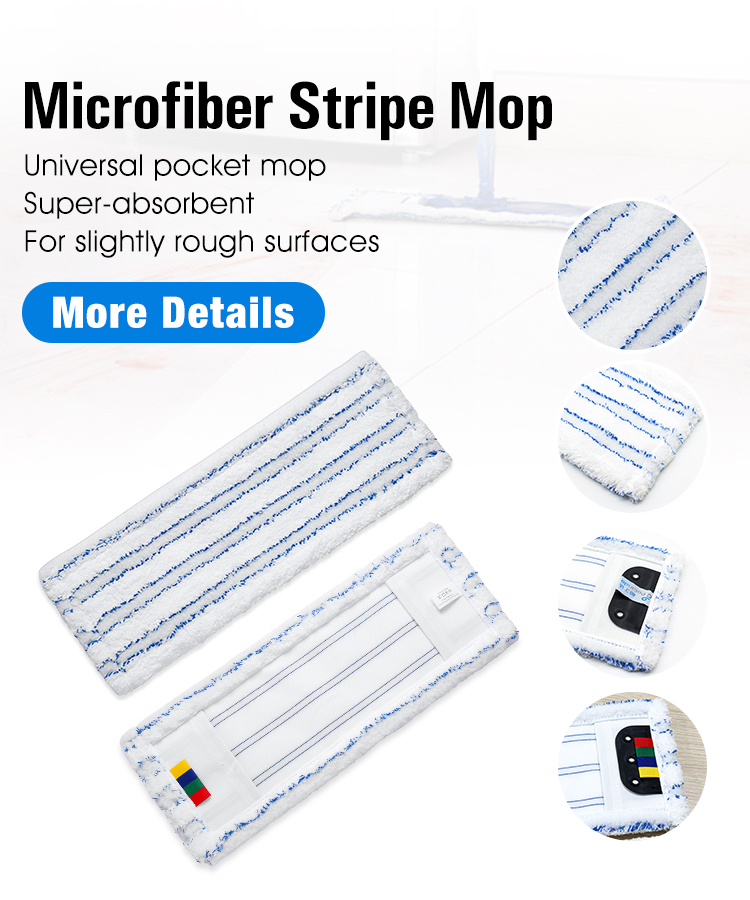 Cover: the MP-014 stripe mop, a colour-coded wet and dry floor pad with a mixed microfiber and nylon striped pile.
Why colour coding fails when it is treated as a labelling exercise
Most colour-coded programmes in commercial buildings begin as a purchasing decision: order pads in four colours, order cloths in four colours, distribute them, and consider the problem solved. The label survives the purchase order but rarely survives a full shift. Two failure patterns repeat across sites.
The first is format blindness. The colour is treated as the whole specification, so any red pad is assumed to behave like any other red pad. In practice, a pad built to capture rough dry soil from a lobby floor, a pad built to lift stubborn marks from a corridor, and a plush washer built for a glass partition will not substitute for one another even if somebody dyes them the same shade. The colour expressed an intent; the construction decides what actually happens on the floor.
The second is scope drift. A cloth enters the restroom at 08:00 and wipes a reception desk at 08:20 because it was the nearest cloth on the cart. No colour system prevents this unless the colour is visible on the item at the moment of use and the zone rule is short enough to remember.
The practical conclusion is that the colour tag must be physically attached to the working surface, not printed only on the cart or the storage bin. This is why the two floor pads in this guide are specified with visible classification features: the MP-014 stripe mop has a back double pocket fixed design with a colour-coded classification tag, and the MP-020 abrasive mop has a back double pocket fixing design with a four-colour classification label intended for area management. Both make the zone assignment readable from a standing position.
Where colour-coded microfiber fits in commercial cleaning today
Microfiber is defined by fibre fineness rather than by brand or price: the term refers to fibre measuring below 1.0 denier, the diameter or fineness of a continuous or filament fibre. That definition matters for buyers because it describes a material class, not a performance grade. Two cloths can both be legitimately sold as microfiber and still differ in blend, pile height, knitting structure and edge finishing.
The market is dominated by the blended construction that makes most cleaning textiles work. Commercial research published by Fortune Business Insights places multicomponent microfiber, the polyester and polyamide blend family, at a 58.0% revenue share of the microfiber cleaning cloth market in 2025. For a procurement team, the useful reading is not the percentage itself but its implication: the specification conversation should be about which blend and which construction sits behind the label, not whether the item qualifies as microfiber at all.
Colour-coded cleaning itself is a long-standing operating convention in commercial, healthcare and food-service cleaning. The code is set by the operator, not by the textile mill — which is why a supplier can provide the tag, the label and the colour options, but cannot decide for the buyer which zone owns which colour. That decision belongs in the site's cleaning schedule.
The three variables that decide the match
1. Construction
Construction is the working surface: the pile type, the fibre blend and any functional stripe or layer. In this range the differences are explicit. The MP-014 uses a mixed microfiber and nylon striped pile at the front, aimed at capturing rough floor dirt. The MP-020 uses a white microfiber main pile with a red PET abrasive stripe for stubborn stain removal. The CG-001 glass washer uses a high-density plush microfiber in a microfiber and polyester blend at 650–680 gsm, while the CG-003 uses a microfiber and acrylic blended plush at the same grammage and adds an optional built-in stain scraper strip on its premium version. Same category, different jobs.
2. Format
Format is how the textile attaches to the equipment and the hand: a flat mop pad with a double pocket back, a terry wet mop, a velcro and elastic fixed washer cover, or a loose cloth. Format decides whether a product is even usable in a given building, because it has to fit the hardware already on the cart. A technically excellent pad that does not fit the mop head in the store room is not a candidate.
3. Colour assignment
Colour is the last variable and the cheapest to change. Both floor pads in this guide support customisation of colour, woven label, printed logo and packing, which means the same construction can be supplied in a site's own colour scheme. The value is in consistency: one colour, one zone, one construction, written down.
Zone 1 — Entrance halls and lobby floors: MP-014 stripe mop
Lobbies receive the coarsest soil in the building: grit, sand and dry dust carried in from outside, followed by whatever moisture arrives with it. The MP-014 stripe mop is specified as a colour-coded commercial wet and dry floor cleaning mop pad in standard sizes of 40 cm and 50 cm, with single piece weights of 100 g and 115 g. Its front mixed microfiber and nylon striped pile is designed for rough floor dirt capture, which matches the entry zone's dominant soil type rather than the polished finish further inside.
Two published performance points matter for scheduling. The pad absorbs up to 7 times its own weight in liquid, and it is reusable over 300 washing cycles. For a lobby that is mopped several times a day, the wash-cycle figure is the more useful number, because it converts a per-piece price into a service life estimate. The manufacturer lists marble, hardwood and ceramic tile as suitable surfaces for both dry and wet cleaning, and lists hotel cleaning services, hospital sanitation, restaurant catering, commercial property maintenance and household floor cleaning among its applications.
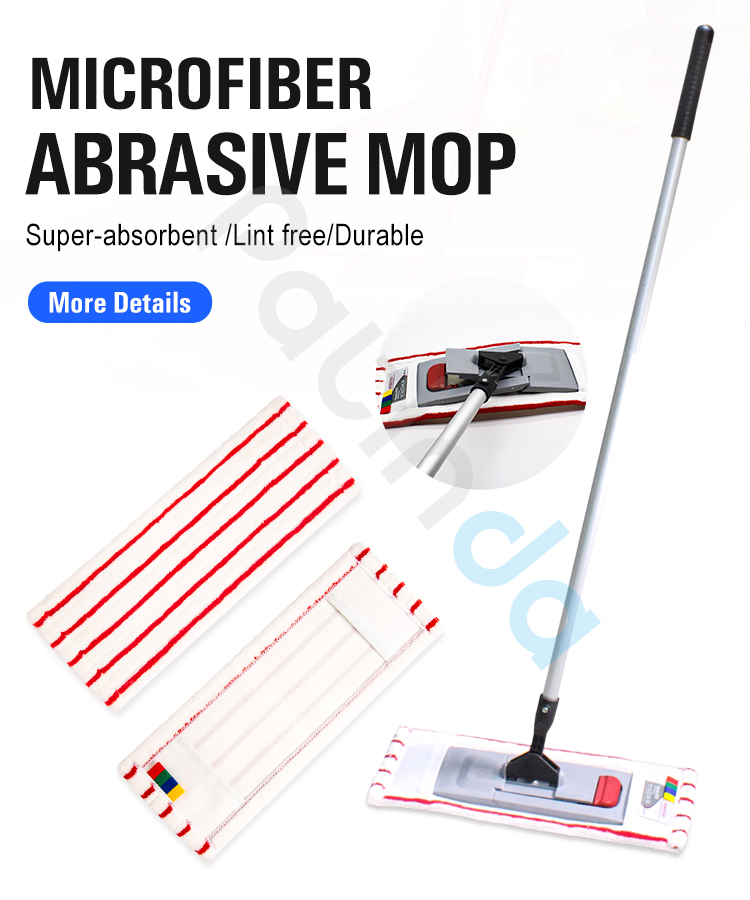 The MP-020 abrasive mop: white microfiber main pile with a red PET abrasive stripe for stubborn marks, plus a four-colour classification label for area management.
Zone 2 — Back-of-house floors with stubborn marks: MP-020 abrasive mop
Corridors behind the front of house, loading areas and service routes collect a different soil profile: scuffs, dried residue and compacted marks that a standard pile lifts slowly. The MP-020 abrasive mop is specified as a colour-coded commercial dual-purpose dry and wet floor cleaning mop pad, available in 40 cm and 50 cm sizes with 80 g and 95 g single piece weights, and with a white microfiber main pile plus a red PET abrasive stripe intended for stubborn stain removal.
The distinction between this pad and the stripe mop is functional, not hierarchical. The MP-014's striped pile targets loose rough dirt; the MP-020's abrasive stripe targets material that has bonded to the surface. The published performance points for the MP-020 are strong dust and hair capture, high water absorption, and a scratch-free result on marble, hardwood and ceramic tile, with reuse after repeated washing and suitability for commercial hygienic graded cleaning. Its listed applications include hospital sanitation, hotel and catering cleaning, commercial property maintenance, school campus cleaning and public facility hygiene management.
Specification note: the MP-020 is published as reusable after repeated washing but does not state a wash-cycle count, whereas the MP-014 states reuse over 300 washing cycles. Do not transfer the 300-cycle figure to the abrasive pad when building a replacement budget — treat the two pads as differently documented until the supplier confirms a cycle count for the MP-020.
Zone 3 — Wet-mopping routes: MT-003 terry wet mop and MP-006 cotton-blend tufting mop
Some routes are wet-mopping routes rather than dust-control routes: kitchens after service, washroom floors, and any area where a wet mop is the established method. Two formats in the range serve this layer. The MT-003 is listed as a microfiber terry wet mop, and the MP-006 is listed as a microfiber-cotton blended tufting mop.
The construction language is worth decoding, because it is the reason both exist. Terry construction uses uncut loops, which is the structure behind the absorbent, textured surface associated with terry wet mops. Tufting introduces yarn into a base fabric, and a cotton-blended tufted pile brings cotton into that surface alongside microfiber. Neither description is a performance promise — the published specifications for these two models in the supplied data cover product name and model rather than weight, size or cycle life, so this guide does not assign numbers to them.
Selection between the two should follow the hardware on site and the mopping method already in the schedule. A site running wet string-mop style setups is choosing a wet mop format and should confirm head fit, backing and handle compatibility with the supplier before ordering, rather than assuming a refill will match an existing head. Where a flat-pad system is in use, the decision returns to Zone 1 and Zone 2 logic. Where a facility runs both systems — common in mixed commercial properties — keep the colour rule intact across both so that a wet mop from the kitchen route never migrates to a patient area.
Zone 4 — Commercial kitchens and food preparation: MD-020, MJ-016 and PVA-002
Kitchen cleaning splits into surfaces, not just floors. The MD-020 is listed in the range as a microfiber universal towel, used in this guide as the general-purpose kitchen cloth for benches, splashbacks and equipment exteriors. The MJ-016 is listed as a double layer microfiber dish cloth, a two-layer construction used for dish and small-item wiping. The PVA-002 is published as a PVA microfiber cleaning cloth in a standard size of 38 × 35 cm with a die-cut finished edge, described as high water absorption, lint-free, streak-free with excellent oil and stain removal, becoming soft after soaking in water.
The PVA-002's published oil and stain removal claim is the relevant one for kitchen work, because grease is the defining soil of the zone. Its listed applications include household kitchen cleaning, tableware wiping, furniture and home appliance cleaning, glass surface maintenance and daily domestic sanitation. Note the scope: the specification is written around household kitchen use, so a commercial operation adopting it should validate performance under its own soil load rather than assume equivalence.
Kitchen colour discipline is the strictest in the building. A cloth that has touched a raw-food preparation surface should not return to a ready-to-eat area, and the colour is the only visible control a supervisor has at a glance. Assign a dedicated colour to the kitchen zone as a whole, and a separate one within it if the site's food safety plan requires a raw and ready-to-eat split. Because the MD-020, MJ-016 and PVA-002 are supplied as loose cloths rather than tagged pads, the colour of the cloth itself carries the entire signal — which is the argument for buying them in zone-assigned colours rather than a single neutral shade.
Zone 5 — Glass, mirrors and window frames: CG-001, CG-003 and MJ-066
Glass is the zone where the wrong tool is most visible to the client. The CG-001 window glass washer is specified as a velcro and elastic fixed replaceable glass cleaning washer cover in 36 cm, 40 cm and 46 cm dimensions, at 650–680 gsm, with a velcro sticker plus elastic loop fixation and a fully wrapped hemmed edge. Its material is a microfiber and polyester blended plush, described as high-density plush microfiber with strong water absorption, lint-free and scratch-free on smooth glass. Listed applications include household window and door glass, bathroom mirror washing, automotive windshield care, and hotel and commercial property cleaning maintenance.
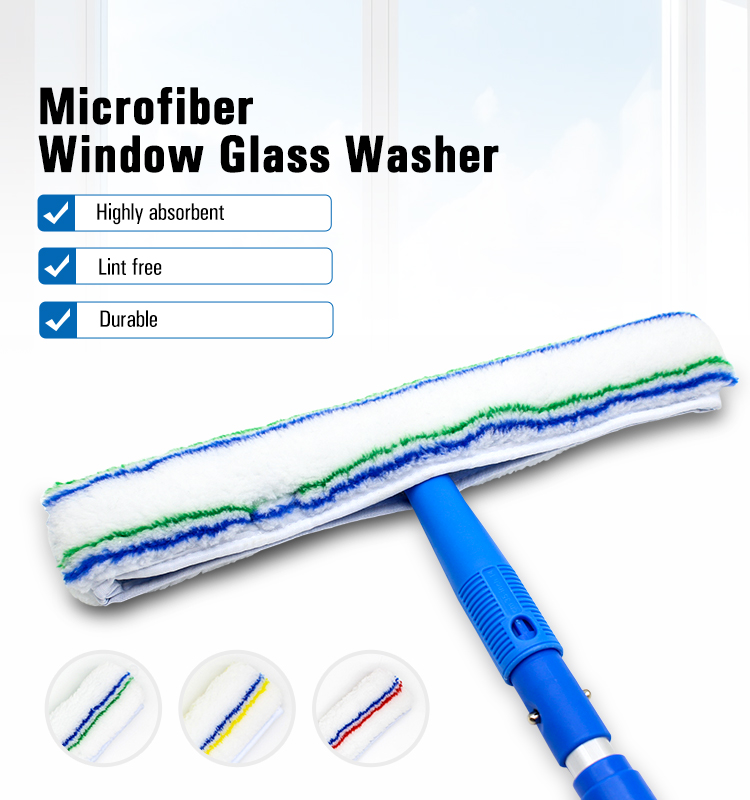 The CG-001 window glass washer: a replaceable plush cover fixed by velcro and elastic loop, specified at 650–680 gsm.
The CG-003 offers a second route through the same zone. It is published as a two-grade, economy and premium, velcro fixed glass washer replacement cover in the same 36/40/46 cm sizes and the same 650–680 gsm grammage, using a microfiber and acrylic blended plush. The premium version has an optional built-in stain scraper strip, which changes the tool's role: the economy grade is a straight washing and wiping cover, while the premium grade can address a bonded mark on the glass without a separate scraper in the hand.
For the final polish, the MJ-066 wineglass wiping towel is specified at 56 g and 40 × 60 cm, with a high-density locking edge at 10–12 stitches per inch, described as lint-free, streak-free and scratch-free polishing with strong water absorption and no water mark residue. Its listed applications include hotel and catering restaurants, bar wine glass maintenance, optical lens cleaning, camera lens wiping, and mobile screen and delicate tableware polishing. In a building application guide it belongs at the end of the glass sequence: wash with the plush washer, then polish with the towel, keeping the two on separate colours so the washing cover never doubles as the finishing cloth.
Zone 6 — Restrooms and high-touch points: one colour, no exceptions
Restrooms are the zone most likely to be cleaned last and cleaned with whatever is left on the cart, so the rule has to be the least negotiable in the document. On floors, both the MP-020 and the MP-014 list hospital sanitation among their applications and are specified as scratch-free on ceramic tile, which makes either technically usable depending on soil type. The control that matters is that the restroom set is a dedicated set — separate pads, separate cloths, separate colour, stored separately — and that the colour is visible on the item during use.
For high-touch surfaces such as dispensers, rails, flush plates and door handles, the range includes universal cleaning cloths listed as MJ-002 and MJ-001. This guide does not assign construction details to them, because selecting a wiping cloth for a specific high-touch regime depends on the disinfectant chemistry in use and the surface finish, and those parameters are set by the site's cleaning plan rather than by the textile specification.
Step-by-step: building the application guide for a real building
- Walk the building and list zones, not rooms. Group areas that share soil type and surface: entrance and lobby hard floors, back-of-house and service corridors, wet-mopping routes, kitchens and food preparation, glass and mirrors, restrooms. Six to eight zones is workable for most commercial properties.
- Record the hardware already in place. Note whether floors are cleaned with flat-pad mop heads, wet mop setups or both, and measure the frame widths for glass work. The published size options in this range — 40 cm and 50 cm for the MP-014 and MP-020 pads, 36/40/46 cm for the CG-001 and CG-003 covers — only help if they match what the site already owns.
- Assign one colour per zone and write it down. The code is a site decision; keep it short enough to be remembered without the document, and keep it consistent across pads and cloths so a cart reads correctly at a glance.
- Match construction to soil type. Rough dry soil at entrances points to the striped pile of the MP-014; bonded marks in service areas point to the abrasive stripe of the MP-020; wet-mopping routes point to the terry wet mop or tufted cotton-blend format; glass points to a plush washer at 650–680 gsm backed by a polishing towel.
- Separate wash and finish tools. A washing cover and a finishing towel are two items, not one. Keeping them on different colours prevents the most common glass complaint: a clean pane with a smear trail left by the tool that did the washing.
- Set the replacement interval from documented figures. Where a wash-cycle count is published, use it — the MP-014 states reuse over 300 washing cycles. Where it is not, as with the MP-020's stated reuse after repeated washing, set a trial interval and revise it with site data rather than importing a number from another product.
- Write the boundary rules, not just the assignments. State which items may never leave their zone, how soiled items are collected, and how the colour tag is checked at shift start. Tag visibility is a design feature worth confirming on delivery: both the MP-014's classification tag and the MP-020's four-colour label are specified as part of the pad's back construction.
- Train on the physical items. Hand each cleaner the pad that belongs to their zone and show the tag. A colour code learned from a wall chart is forgotten; a colour code learned from the pad in the hand is not.
Use cases: where this zone logic earns its keep
Hotels and catering operations. The MP-014 is listed for hotel cleaning service and restaurant catering, and the MP-020 for hotel and catering cleaning. A hotel runs at least four soil profiles under one roof — lobby grit, corridor scuffing, kitchen grease and washroom floors — and each maps to a different item in this guide. The published customisation options, including customisable colour, woven label and printed logo, allow the property's own colour scheme to be applied to the pads.
Hospitals and sanitation contracts. Both the MP-020 and the MP-014 list hospital sanitation among their applications, and the MP-020 is additionally described as suitable for commercial hygienic graded cleaning. In this setting the audit trail matters as much as the cleaning result, which is why a visible, stitched or printed classification feature is more useful than a cart-level label.
Schools and public facilities. The MP-020 lists school campus cleaning and public facility hygiene management. Large mixed sites typically combine flat-pad mopping in halls with wet mopping in service areas, so the colour rule has to survive a change of format — the same discipline applied to the MT-003 terry wet mop and the MP-006 cotton-blend tufting mop as to the flat pads.
Commercial property maintenance and distributors. Commercial property maintenance appears across the mop, washer and cloth specifications in this range. For a distributor building a zone-based catalogue, the useful structure is exactly the one in this article: zone, format, construction, colour. Foshan Patinda Housewares Co., Ltd. reports exports at 98% of output across markets including the USA, Canada, Australia, the UK, Germany, France, Italy, the Netherlands, Russia, Japan, Korea, Switzerland, Sweden, Turkey and Saudi Arabia, which is relevant when a distributor needs the same zone logic replicated across several country programmes.
Zone-by-zone summary table
| Zone | Format in this guide | Published construction points | Colour control | Confirm before ordering |
|---|---|---|---|---|
| Entrance and lobby hard floors | MP-014 stripe mop, 40 cm / 50 cm | Microfiber and nylon striped front pile for rough dirt; 100 g / 115 g; absorbs up to 7× own weight; reusable over 300 washes; scratch-free on marble, hardwood, ceramic tile | Back double pocket with colour-coded classification tag | Pad fit to existing flat mop head; colour of tag matches site code |
| Back-of-house and service floors | MP-020 abrasive mop, 40 cm / 50 cm | White microfiber main pile plus red PET abrasive stripe; 80 g / 95 g; strong dust and hair capture; high water absorption; scratch-free on marble, hardwood, ceramic tile | Back double pocket with four-colour classification label | Wash-cycle life, which is not published for this model |
| Wet-mopping routes | MT-003 terry wet mop; MP-006 cotton-blend tufting mop | Terry wet mop format; microfiber-cotton blended tufted construction | Site-assigned dedicated colour per route | Head, backing and handle compatibility with existing equipment |
| Commercial kitchen | MD-020 universal towel; MJ-016 double layer dish cloth; PVA-002 PVA cloth, 38 × 35 cm | PVA-002: die-cut edge, high absorption, lint-free, streak-free, oil and stain removal, softens after soaking | Colour of the cloth carries the whole signal | Whether household-scope performance claims hold under commercial soil load |
| Glass, mirrors, windows | CG-001 and CG-003 washers, 36/40/46 cm; MJ-066 polishing towel, 40 × 60 cm | 650–680 gsm plush; velcro plus elastic loop fixation; fully wrapped hemmed edge; CG-003 premium has optional built-in stain scraper strip; MJ-066 locking edge 10–12 stitches per inch | Wash cover and polish towel on separate colours | Frame width match; economy versus premium grade choice |
| Restrooms and high-touch points | Dedicated MP-020 or MP-014 set plus universal cleaning cloth | Both mops list hospital sanitation and ceramic tile suitability; cloth constructions not specified in this guide | Dedicated colour, stored and laundered separately | Disinfectant chemistry compatibility for high-touch wiping |
What these specifications do and do not establish
The published data supports clear statements about size, weight, grammage, structure, fixation method and stated surface suitability. It supports the claim that the MP-014 absorbs up to 7 times its own weight in liquid and is reusable over 300 washing cycles, that the CG-001 and CG-003 plush covers are specified at 650–680 gsm, and that the MP-020 carries a red PET abrasive stripe for stubborn stain removal. Those are specification facts a buyer can write into a tender document.
The same data does not establish comparative superiority between models, a measured cleaning result on a specific floor finish, or a validated cycle life for every item in the range. It also does not establish certification. Foshan Patinda Housewares Co., Ltd. lists OEKO-TEX STANDARD 100, ISO 9001:2015, ISO 45001:2018 and GRS among its certifications; because these are published as company statements, each should be confirmed against the issuing body's registry before it enters a contract, a tender response or a retail claim. Buyers should also note that chemical safety requirements move: the OEKO-TEX Association's STANDARD 100 was updated in 2024 to include a total fluorine limit of 100 mg/kg to address PFAS regulations, so a certificate's issue year is part of the check, not an administrative detail.
Frequently asked questions
What should a buyer verify before accepting a colour-coded microfiber system on a food-service or hospital site?
Three checks. First, the colour control must be physically attached to the working item and legible during use — the MP-014 carries a colour-coded classification tag in its back construction and the MP-020 carries a four-colour classification label intended for area management. Second, item-level chemical safety documentation should be requested and dated, because OEKO-TEX STANDARD 100 was updated in 2024 with a total fluorine limit of 100 mg/kg under PFAS regulation. Third, any certification the supplier lists, including OEKO-TEX, ISO 9001:2015, ISO 45001:2018 and GRS, should be confirmed against the issuing body's registry rather than accepted from a brochure.
Can one mop pad handle both dry dusting and wet mopping?
Both floor pads in this guide are specified as wet and dry pads. The MP-014 is a colour-coded commercial wet and dry floor cleaning mop pad, and the MP-020 is a dual-purpose dry and wet floor cleaning mop pad. Handling both tasks is not the same as performing them identically: the MP-014's striped pile is aimed at rough floor dirt capture and absorbs up to 7 times its own weight in liquid, while the MP-020's abrasive stripe targets stubborn marks. Operating guides should still specify separate pads for dusting and wet work within a zone where the site's hygiene plan requires it.
Which pad should be assigned to scuff marks and dried residue?
Assign the MP-020 abrasive mop. Its structure is a white microfiber main pile combined with a red PET abrasive stripe intended for stubborn stain removal, and it is specified as scratch-free for marble, hardwood and ceramic tile with strong dust and hair capture. Keep it on a colour that never appears in the lobby dust route, so the abrasive surface is not worn on loose grit that a striped pile would have captured first.
What drives the cost of a colour-coded programme?
No price is quoted in this guide, and the published data does not include unit pricing. The variables that move cost are visible in the specifications: pad size (40 cm versus 50 cm), piece weight (80 g / 95 g for the MP-020 and 100 g / 115 g for the MP-014), grammage for glass covers (650–680 gsm), and customisation scope, which for these products covers colour, woven label, printed logo and packing. Replacement frequency is the largest controllable element, and it is why a published wash-cycle figure such as the MP-014's 300-plus cycles belongs in the cost model.
What should a sample evaluation actually test?
Test the items as they will be used. Verify the piece weight and dimensions against the specification, check that the classification tag or label is firmly attached and still legible after a wash cycle, confirm pad fit on the mop head in use, and confirm frame fit for the 36/40/46 cm washer covers. For glass, run the full sequence — plush washer at 650–680 gsm followed by the polishing towel — and inspect the pane after it dries rather than while it is still wet. Record results per zone, not per product, because the zone is the unit the cleaning schedule operates on.
What are the ordering parameters, and how long does a programme take to set up?
For this range, the published commercial parameters are a minimum order quantity of 3,000 pieces, a lead time of 30–45 days, a monthly capacity of 182,022 kg, OEM/ODM production with customisation across size, weight, logo, material, fabric texture, printing, colour, accessories, packing, shipping label and GSM, and 100% testing. For context on scale, the manufacturer records 200 employees, a 17-engineer R&D team, and annual output of 2,184,270.46 kg from a 45,000 m² plant with more than ten automatic cutting and sewing lines. A zone programme therefore fits comfortably inside one order cycle once the colour map is agreed — the binding constraint is usually the site's internal sign-off on the colour code, not production.
Conclusion: the colour is the control, the construction is the work
A zone-by-zone microfiber programme is not a product list. It is a short set of decisions: which zones exist in the building, which construction matches each zone's soil and surface, which format fits the equipment already on the cart, and which colour makes the whole thing auditable at a glance. The MP-014 stripe mop, MP-020 abrasive mop, MP-006 cotton-blend tufting mop, MT-003 terry wet mop, MD-020 and MJ-016 kitchen cloths, PVA-002 cloth, CG-001 and CG-003 window glass washers and MJ-066 polishing towel each occupy a defined place in that structure, and the published specifications — sizes, weights, grammage, pile structure, fixation method and stated surface suitability — are sufficient to write a first version of the guide without a single unsupported claim.
Where the specification stops, the buyer's verification begins: confirm certificate status with the issuing body, confirm wet mop and pad fit against existing hardware, and set replacement intervals from published figures rather than assumption.
Next step for buyers and distributors. The full product and specification set for these formats is available in the Pa Tin Da 2024 e-catalogue (PDF). For zone-specific sample requests, colour assignments or a quotation, contact Foshan Patinda Housewares Co., Ltd. through www.microfiberchina.com — the sales team can confirm tag options, packaging and the customisation scope available on the mop pads, cloths and glass washers covered in this guide.
Have Questions or Need More Details?
Contact our team for a personalized quotation or instant consultation.
Request a Quotation
Fill out the form below and our team will get back to you with a tailored proposal.
WhatsApp Direct Chat
Prefer to chat in real-time? Message us on WhatsApp for instant assistance & quick answers.
- Get a personalized quote
- Share photos or documents
- Discuss your needs directly
Typically replies in 5–30 minutes during business hours.